Published Oct 14, 2026, 12:00 PM EDT
**Charlie Ridgely **is a writer from Maryland, currently residing in Nashville, Tennessee. He may be new to Collider, but he’s been writing, editing, conducting interviews, and podcasting around the industry for 10 years. From 2016 to the start of 2026, Charlie was a full time writer and critic at ComicBook.com. A lifelong movie fan, avid reader, and renowned (fictional) dungeon explorer/dragonslayer, Charlie is a jack-of-all-trades throughout the fandom multiverse and has covered everything under the sun.
Sign in to your Collider account
When people plead for movie theaters to once again be filled with mid-budget dramas and thrillers for adults, I’m not sure that the story of a guilt-riddled young man getting swallowed alive by a sperm whale is what they had in mind. But that’s the movie we got with Whalefall, and it’s the perfect answer to our big screen wishes. This is a movie that feels like something that would have been released 20 or 30 years ago, in that it’s effective, character-driven, confidently made, and doesn’t spend a single moment shying away from its earnestness or idiosyncrasies. It’s the kind of thriller that both feels like a movie you’d catch during a cozy afternoon watching TNT on the couch with your dad, and something totally new that you haven’t quite seen before.
Whalefall, directed by Spontaneous and No One Will Save You helmer Brian Duffield, is an adaptation of reigning Pulitzer Prize winner Daniel Kraus’ bestselling 2023 novel of the same name. It’s a book about survival and the complicated relationships between parents and children that, upon reading, felt wholly unadaptable. How could anyone not only set an entire movie within the scientifically accurate stomach of a whale, but somehow also keep audiences on the edge of their seats? Thankfully, the word “impossible” isn’t in Duffield’s vocabulary, and he has delivered a masterful, pulse-pounding thriller that I was ready to watch again the moment it ended.
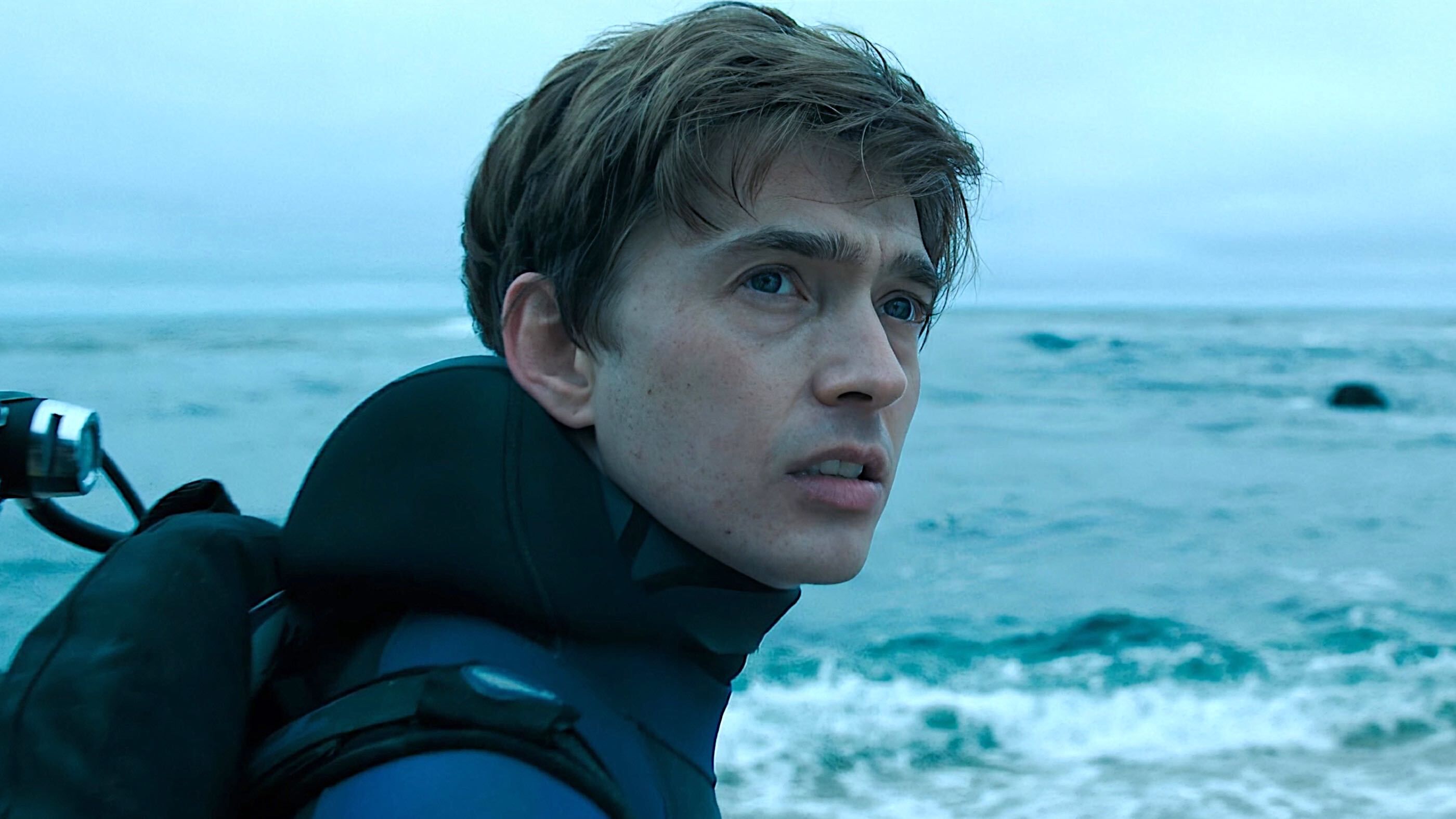
Whalefall follows a young man named Jay Gardiner (Austin Abrams), who is carrying around a massive amount of grief and guilt after the death of his father (Josh Brolin). Diving was his dad’s passion, and Jay attempts to get some closure by strapping on his scuba gear and trying to find his father’s missing remains. This journey of mourning, however, turns into a fight for survival when he gets tangled up with a giant squid and swallowed whole by a whale.
Kraus’ novel is famously accurate to the real biology of whales, and scientifically sound in its exploration of exactly what it might take for a human to survive being trapped inside one. But more than that, Whalefall is the story of a father and son, and the sometimes inescapable burden that each side of that relationship can bear if you’re not careful. The story of Jay’s journey inside the whale is exhilarating, but it’s his journey with grief and the memory of his father that ultimately feels the most engaging.
Without offering up any spoilers, the relationship between Jay and his dad is explored with an earnestness that is all too absent from big movies today. Many filmmakers would be tempted to either remove some of the emotional components present in the third act of the book from the film, or at least make a couple of jokes about their existence, just to try and save face with an audience who might not be game for a near-supernatural level of sincerity. But Duffield couldn’t care less about that, and puts that element of Kraus’ novel at the forefront, almost daring you not to love it.
It’s that sincerity that makes Whalefall stand out amongst its peers. Well, that and some of the most daring and immaculate sound design to hit the big screen in years.
Abrams is rightfully going to get a ton of credit here, but it would be impossible to talk about Whalefall without mentioning the sound design and score. I can’t remember the last time that the sound played such an important, immersive role in a film like this, and turned a genuinely great movie into a truly unforgettable theatrical experience.
From the first moment that Jay gets into the water, you realize you’re in for something sonically different. The sound of the waves rising and falling instantly envelops you in a way that makes your heart rate start to rise. Once the whale shows up, things get kicked into an even higher gear, immersing the entire theater in a way you might not think possible without actual water being involved. It feels almost suffocating at times, but in a good way; the sound design makes you feel like you’re in there with Jay. Every movement of the whale, every crack of Jay’s bones, is sent straight through your spine. Like the whale, this sound design will swallow you whole, showing off the might of the big screen experience in a way few other films have ever done.
The cherry on top of that immaculate sound is the vibrant, sometimes bombastic score from Joseph Trapanese. His music here is Big with a capital B, giving and taking as necessary to set the white-knuckle pace for everyone else involved. There’s one moment, when the whale is racing to the surface, that the drums of Trapanese’s score just run straight through your bones like a freight train, turning what was an exciting movie-watching experience into a pulsating, full-body thrill-ride.
Whalefall is a lot of things: It’s terrifying, awe-inspiring, moving, a little sappy, unbelievably earnest, and wholly memorable. Above all, though, Whalefall is confident. It’s the kind of confidence that lets you know you’re in for a treat from the first moment the screen comes to life, and the kind of confidence that turns what could’ve been an average movie into something we’re going to be talking about and re-watching for years to come.
](/tag/movie/whalefall/) ‘Whalefall’ is a pulse-pounding thriller with a big heart on its sleeve.