Memorable side characters make up for some lackluster writing.
Belmont’s Curse takes the Castlevania gameplay formula in a thrilling new direction.
It’s not Symphony of the Night, but it’s still beautiful.
A driving soundtrack is generally effective, but never truly inspired.
*Castlevania *was long overdue for a comeback, but resurrecting the series isn’t all that simple. In a market thoroughly saturated with alternatives, it would be all too easy for Dracula to trip on the way back to his rightful throne. The *Bloodstained *series has picked up the torch for both linear, Classicvania design and the sprawling style of games like Symphony of the Night, while *Hollow Knight *and its ilk have more broadly pushed the Metroidvania genre forward.
*Castlevania: Belmont’s Curse *doesn’t take any of the easy paths. Developed by Konami and Evil Empire, the studio behind the *Dead Cells: Return to Castlevania *DLC, the new entry cobbles its design together from every influence you can imagine. It might lose the simple magic of the franchise’s greatest entries, but *Castlevania: Belmont’s Curse *delivers something exciting in its place.
In typical Metroidvania fashion, *Castlevania: Belmont’s Curse *starts small. Rose Belmont, the daughter of Trevor Belmont who takes center stage as the new protagonist, can’t do all that much at the beginning. She’s in over her head both narratively and mechanically, forging impetuously ahead by jumping, sliding, dodging, and slashing.
While this toolkit sounds familiar enough, it doesn’t feel quite like any other game. Like Dead Cells, it’s all fast and fluid. At the same time, *Belmont’s Curse *is also indebted to the methodical, momentum-arresting precision of old-school *Castlevania *games, and getting used to the gravity-laden arcs of Rose’s jumps can take a minute.
The first boss of *Belmont’s Curse *puts this acclimation to the test, with a chunky health bar and the aggression to match. Mastering it can be a skill check, but it’s also a great window into how good the game can feel. Finding a sweet spot between deliberate *Castlevania *movement and free-flowing agility is a tricky task, and *Belmont’s Curse pulls it off without simply rehashing the approach of Symphony of the Night *and its successors.
As *Belmont’s Curse *progresses, it stretches its legs, adding to Rose’s abilities with new weapons, charms, and traversal upgrades that let her swing from hooks, smash through rocks, and more. The map unfolds in turn, revealing countless dusty corners for Rose to poke around in at her leisure. Aspects of *Belmont’s Curse *are still linear, and the succession of required bosses is only so flexible, but there’s a lot to explore.
In true *Castlevania *fashion, both the castle and its surroundings are packed with legitimate enemy threats, and surviving from one save point to the next can be a challenge. Although *Belmont’s Curse *is never as hard as an 8-bit *Castlevania *game, it’s tough enough to make progression exciting.
With enough time spent exploring, the difficulty curve starts to fall off, as Rose gains levels along with the discrete upgrades. If boss fights start to feel trivial, you can always fall back on a lesser weapon, but the final iteration of each weapon family might be too cool to ignore. The tarot system is also a lot of fun, granting Rose with power-ups from each boss she beats with perks unlocked by completing challenges.
The platforming, meanwhile, requires attention from start to finish. While more of it relies on flipping blocks on and off to avoid spikes than I’d personally prefer, it’s well-designed and occasionally exhilarating. It’s also not afraid to make progression require some thought, with a few clever puzzles and plenty of tucked-away triggers. If you get unlucky with the order of your personal discoveries, backtracking might get tiresome, but figuring out the way to the next challenge is usually satisfying.
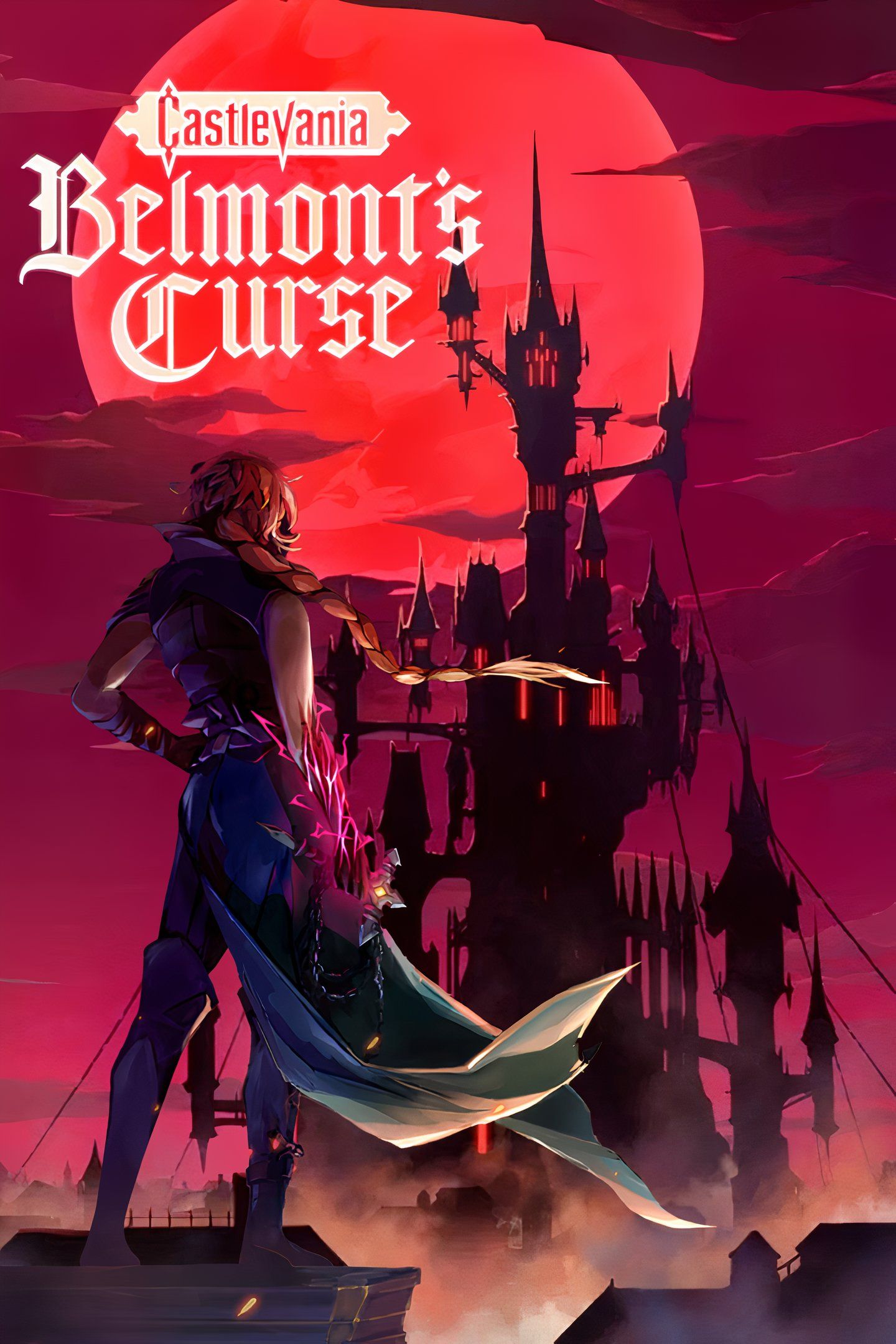
Great gameplay is only part of what makes *Castlevania *special. Atmosphere is also important, and it’s another area where *Belmont’s Curse *isn’t afraid to rewrite the formula. There’s a lot of old-school influence in the art direction — some elements come across as a liberal reinterpretation of Rondo of Blood’s style — but the cartoon 2.5D look is ultimately its own beast.
*Belmont’s Curse *admittedly loses certain touches of familiar *Castlevania *atmosphere, and the way it employs its vivid color palette rarely recaptures the nostalgia of stalking moody, candle-lit hallways half-submerged in gloom. All the same, it’s gorgeous enough to make up for it. Whether the deeply layered backgrounds reveal flaming cities, juddering clockwork, or blood-red skies, the sense of artistry on display is frequently astounding.
The music undergoes a similar transformation, setting aside many of the Baroque touches in favor of something more aligned with current trends. This pivot isn’t always a bad thing, and one or two tracks reminded me of Ludwig Göransson’s success in populating the *Star Wars *soundscape with new genre influences. Nothing ever reaches the heights of Castlevania’s best music, however, and the score’s general efficacy at driving momentum is often undercut by muddy mixes or a lack of truly memorable melodies.
*B**elmont’s Curse *is also a mixed bag in the narrative department,mostly due to Rose’s character. Despite saying a lot, she doesn’t seem to have a lot to say, and her character never feels like much more than an underdeveloped trope. It’s a disappointing fate for the daughter of Trevor and Sypha, although one that a sequel might be able torectify.
In other parts, however, the writing can be a lot of fun. The dialogue in Belmont’s Curse is at its best when one of the game’s various eccentrics starts monologuing, like a mad King Arthur from a stained-glass window. Even if some bosses feel more like anime characters than chilling threats, they’re all memorable.
Castlevania: Belmont’s Curse’s attempt at pushing the series forward isn’t always a slam dunk, and seeing the influence of modern Metroidvanias creep into one of their key progenitors can trigger a protective impulse. Most of it works, though, and most of what works *really *works.
There’s a lot here for *Castlevania *fans to enjoy, with everything from charming series staples to brilliant new ideas capable of sparking genuine joy. More than anything else, *Castlevania: Belmont’s Curse *is incredibly fun to play. At the end of the night, when Dracula is finally dead once more, isn’t that what *Castlevania *is all about?