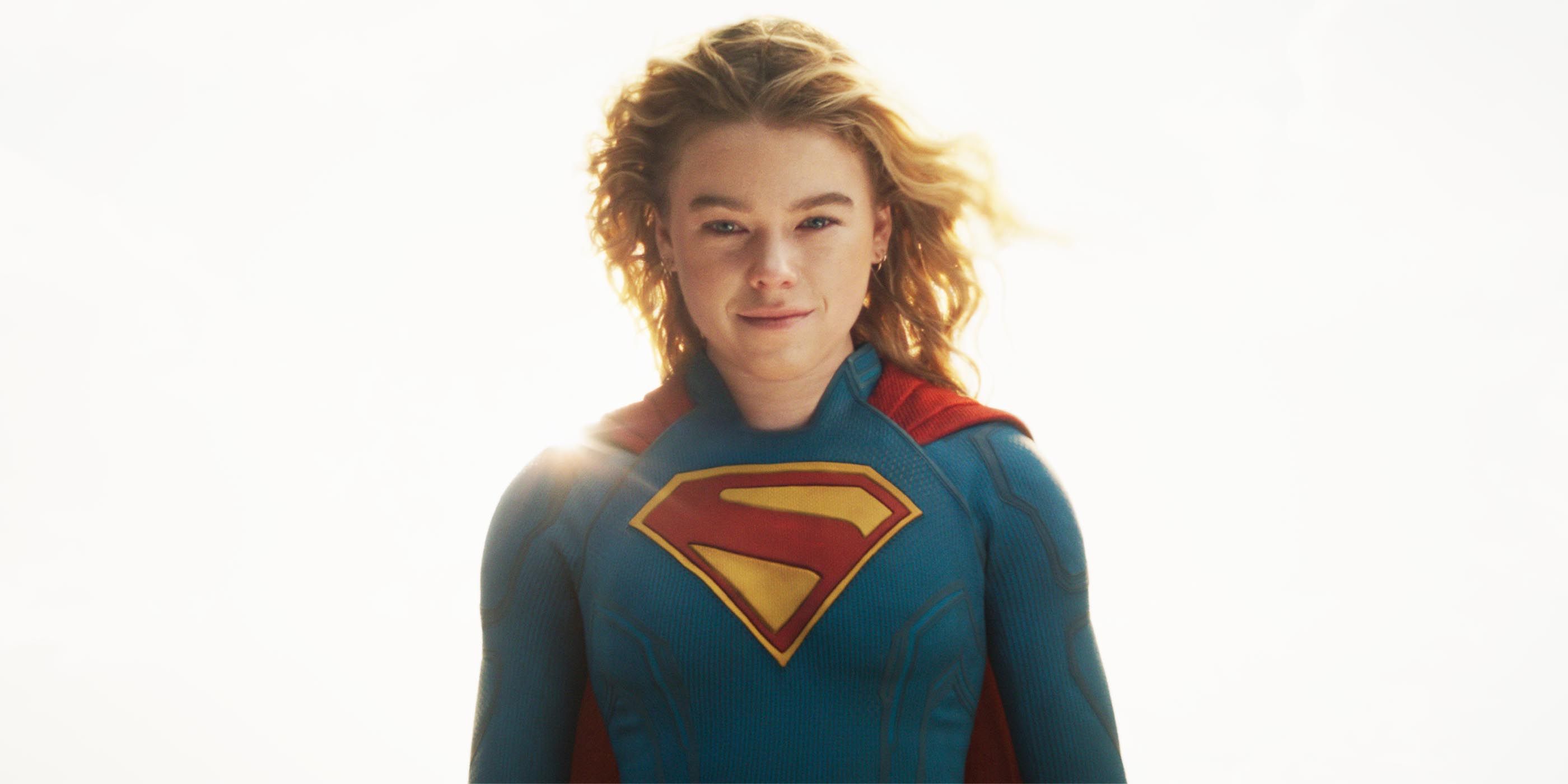
When Milly Alcock’s Kara Zor-El first stumbled into the Fortress of Solitude at the end of Superman, she was unlike any other version of Supergirl we’ve seen on screen. She drunkenly crashed into the fortress, giggling while getting tossed around like a rag doll by Krypto, and then peaced out as quickly as she arrived — calling Clark (David Corenswet) a bitch as she walked out the door. The short scene completely rewrites the character for most fans who have only known Supergirl through TV and movies. Meanwhile, comic book fans quickly identified that this version of Kara was inspired by Supergirl: Woman of Tomorrow, an eight-part series by Tom King, **Bilquis Evely, **and Mat Lopes.
Fast-forward almost a year later, and Supergirl is officially on our movie screens with the famous superhero helming her own movie in her own chaotic way. Directed by Craig Gillespie and written by Ana Nogueira, the film follows Kara as she celebrates her 23rd birthday, partying and getting drunk on power-dulling planets with red suns until she meets a young girl on a quest of revenge that completely derails her planned festivities. With nonstop action and a heartbreaking story at its core, Supergirl has made her mark on the DCU as the definitive and best version of the superhero to date.
At the heart of Supergirl is, unsurprisingly, Alcock’s Kara Zor-El. A far cry from her golly, gee-whiz cousin, Kara is a tragic figure, one who has been haunted by grief and the loss of her entire civilization. Although both Gillespie and producer James Gunn have called Kara an antihero, Kara doesn’t lack in moral integrity, nor does she shy away from being a good person; she’s just also someone who has been robbed of everything. She witnessed the destruction of her home planet and then watched as Argo City — the force-field-protected remnant of Krypton — slowly succumbed to its death. Unlike Clark, who got in an escape pod to Earth as a baby and was raised on a wholesome Kansas farm, Kara spent her childhood on Krypton, surrounded by Kryptonians, before being finally sent to Earth when there was no other option.
It’s hard to imagine anyone else embodying Kara other than Alcock, who plays the character with all of the gravitas she demands in these painful moments of retrospection, where she flashes back to Kara’s childhood. Yes, she’s a party girl and a bit bratty at times, but beneath all that bluster and inebriation is someone who is suffering, and that’s clear to see under the surface of every scene she’s in. Perhaps in another actor and writer’s hands, Kara might have fallen into the trap of becoming a manic pixie dream girl, but Nogueira delivers a script that never hesitates to look directly at the bleakness and injustice of the universe, and Alcock never hesitates to lean Kara into pointing out that reality.
Before she became a Targaryen or a Kryptonian, she drove across Australia with Tim Minchin.
Thanks to her time on House of the Dragon (which also introduced Gunn to the actor for the first time), Alcock is a pro at fictional languages now. Her most devastating scene involves her flawlessly delivering a full scene of Kryptonian dialogue across Kara’s father, David Krumholtz’s Zor-El. It’s in these moments on Krypton where the film is most likely to tug at your heartstrings. Contrasted with the hardened woman we see today, the Kara of the past has all of her emotions written right on her face, and Alcock proves that she’s just as skilled in these quiet moments as she is at kicking ass.
What works fantastically in the film is Kara’s relationship with Eve Ridley’s Ruthye Marye Knoll, a young girl who is hellbent on avenging her family after they were all slaughtered by Krem of the Yellow Hills (Matthias Schoenaerts), the vicious leader of a group called the Brigands. Ridley is perfect as the plucky Ruthye, who is one part sidekick and two parts Inigo Montoya. She never hesitates to run into battle with her father’s sword drawn, ready to help, but what makes her character work is how adamant Kara is in protecting her and preventing her from exacting revenge. Alcock and Ridley embody the classic reluctant hero and energetic sidekick duo, and the chemistry between the two actors is both what makes the film so fun while also being the thing that anchors it in its sincerity.
What does not work as well is Jason Momoa’s Lobo. While Momoa is exceedingly entertaining as Lobo and the character is definitely going to be a fan-favorite, his inclusion in the story feels somewhat shoehorned in. Although Lobo was originally part of Tom King’s pitch for Supergirl: Woman of Tomorrow, he doesn’t actually appear in the comics run. His inclusion feels like an addition meant to please fans of the comics rather than actually serve the narrative. In fact, Lobo could easily be cut from the story without any real impact on the plot. It’s disappointing, especially coming from a film produced by Gunn, who was able to turn someone like Drax the Destroyer into one of the most complex characters of the MCU. What we get of Lobo is rather shallow, and while his presence serves as a strong introduction to the character, a bit too much screentime is given to him without any real narrative payoff.
If anyone deserves the “antihero” label in the film, it’s Lobo, who doesn’t seem to care much about what the Brigands do, only that he gets his bounty. Of course, if they were just robbing people blind maybe it wouldn’t be that bad. But Supergirl introduces a villain who is far more repulsive simply due to the fact that Krem and his men not only pillage and raze the towns they go to, but they systematically abduct young girls to forcibly make them “brides” so they can continue expanding their group. Considering Ruthye’s own story and Kara’s role as her protector, it then feels like a missed opportunity when the film neglects to really give us any moments between Kara and these girls she is rescuing, especially when they deliver a Mad Max: Fury Road-like moment near the end.
Despite these flaws, Supergirl is a fantastic film and one that solidifies the newly rebooted DCU’s strength as a franchise. It also signals that Gunn can be a bit more hands-off with a project without any drop in quality. Supergirl is as effervescent and colorful as Superman, but offers a cosmic twist that sheds away the extra baggage that comes with centering a story on Earth and takes the opportunity to truly develop this new version of the character. Unsurprisingly, Supergirl also has its fair share of needle drops, which adds to the rhythm and pace of the film. However, Claudia Sarne’s score also deserves some recognition as it dominates some of the most emotionally satisfying scenes.
As far as the action goes, it is pretty much non-stop. With or without a yellow sun, Kara is brazen and bold with her attacks, and the dynamic action sequences see her utilizing all of her strength and powers seamlessly. It’s a stark contrast to Clark’s fighting style, which also serves as a nod to the difference in these two characters. Speaking of the Man of Steel, Corenswet appears in a surprising number of scenes, from leaving Kara video messages asking her when she’ll be home to appearing in flashbacks to when Kara first arrived on Earth. Though we might have only gotten a couple of seconds of the cousins’ dynamic in Superman, this film offers us a much more intimate look at their complicated relationship and makes us hope that Kara will have a more dominant role in Man of Tomorrow. She’s clearly proven herself to be a formidable opponent, and who can say no to a messy superhero and her adorable but chaotically destructive superpup?
](/tag/movie/supergirl-2026/) Milly Alcock gives DCU fans the definitive version of Supergirl, a flawed and complex superhero unlike any we’ve ever seen before.
Survivor Kara Zor El is still haunted by Krypton’s collapse, drifting across the galaxy with Krypto at her side. When a young warrior named Ruthye begs for help avenging a family tragedy, Kara gets pulled into a ruthless hunt for Krem of the Yellow Hills.