Published Jun 24, 2026, 12:00 PM EDT
Alex is the Senior Editor of Reviews & Prestige Content, overseeing ScreenRant’s film reviews as one of its Rotten Tomatoes-approved critics. After graduating from Brown University with a B.A. in English, he spent a locked-down year in Scotland completing a Master’s in Film Studies from the University of Edinburgh, which he hears is a nice, lively city. He now lives in and works from Milan, Italy, conveniently a short train ride from the Venice Film Festival, which he first covered for SR in 2024.
Sign in to your ScreenRant account
Bad movies come in all shapes and sizes, but the ones I’m most fascinated by are those that resemble, often quite closely, the good version of what they’re trying to be. They’re put together with enough production value to be taken seriously from that perspective, and they lean hard into the tropes of their respective genres – story or filmmaking choices that you’ve seen work time and time again. But this time, they don’t. They walk like ducks, they talk like ducks, but for a reason you can’t always put your finger on, they are just not ducks.
Lucky Strike is one of those. This Second World War action thriller, set during the Battle of the Bulge, does a lot of things I usually like. It features numerous set pieces that balance explosive scale with intimate, close-quarters danger. It’s often intriguingly shot, aiming to immerse us in the perspective of the protagonist as he survives one trial after another. And it makes the decision not to subtitle the German or French spoken throughout, while also casting people who can convincingly speak those languages.
Yet, despite all that, Lucky Strike is simultaneously so familiar and so off that it sometimes feels like WW2 movie cosplay. While watching, I thought often about how that is essentially what all period filmmaking is – anyone who’s ever seen an unofficial set photo will know what I’m talking about – but whatever movie magic that usually gets us to suspend our disbelief is just totally absent here. Aside from the intellectual curiosity of trying to diagnose that, the viewing experience is fairly dull.
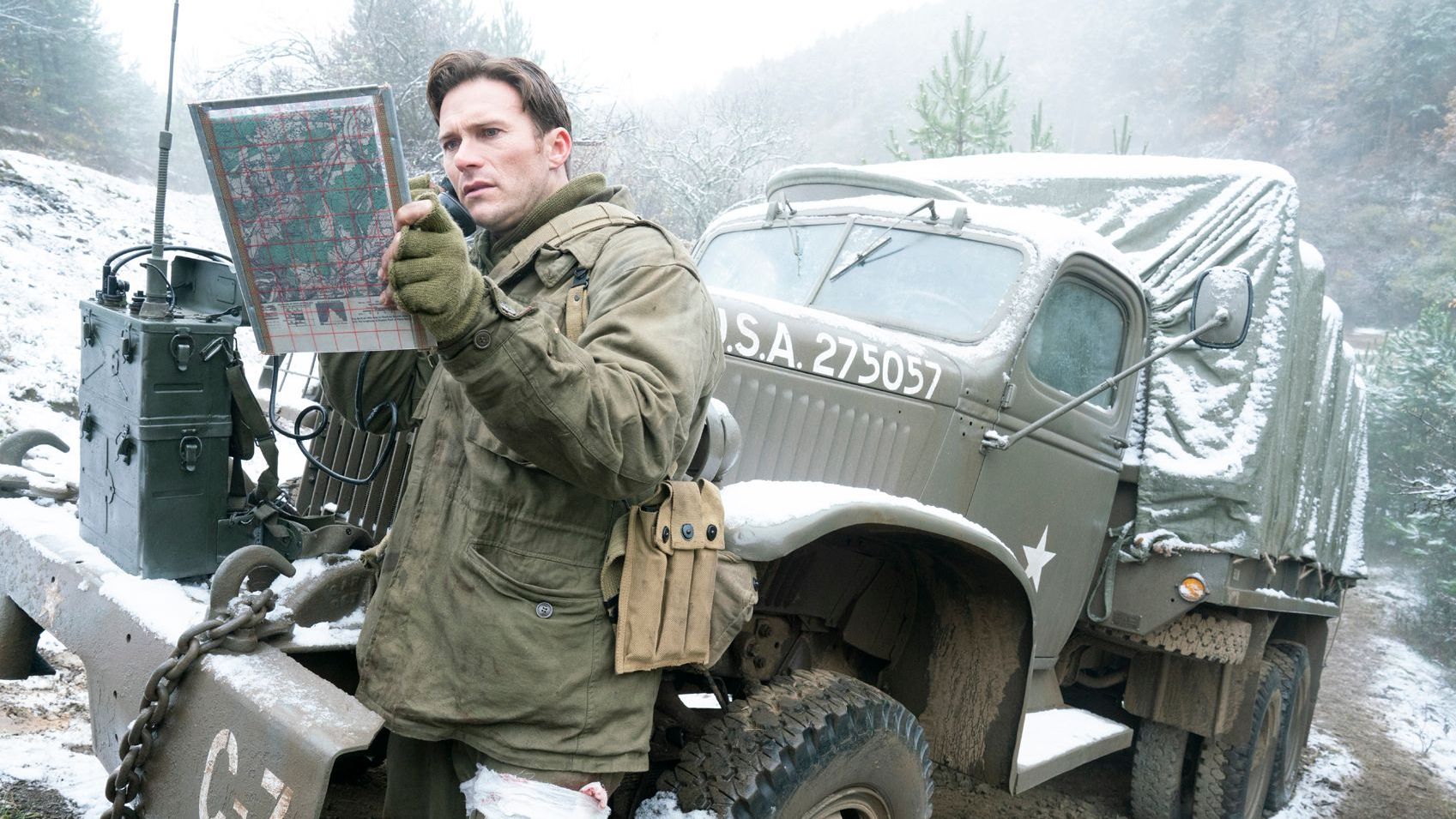
Inspired by true events, Lucky Strike is primarily one American soldier’s improbable survival story. In a post-war prologue, Colonel John Castle (Scott Eastwood) visits Mrs. Caldwell (Aunjanue Ellis-Taylor), an ex-employee of Galvin Manufacturing (later renamed Motorola) being screwed over on her pension. Though she’s at first reluctant, Castle is determined to speak with her, and he shares his experience in Belgium in 1944, during a brutal German counteroffensive known as the Battle of the Bulge. He was still a captain then, in the 324th Engineer Combat Battalion, and he and his men were tasked with blocking a road to hinder the advance of an elite SS tank unit.
Things go south quickly, and before long, all of Castle’s men are dead. Still equipped with a radio he wears on his back, he learns that no help is coming; already wounded, he must make it across enemy terrain to a distant checkpoint if he hopes to survive. On top of the freezing weather and constant risk of being hit by artillery fire, there remains the looming threat of the SS, who Castle has been warned will murder whoever they come across without mercy.
Without any believable people to latch onto, the action has no human stakes.
At times, you can feel how badly Lucky Strike wants to feel like *Band of Brothers, *even going so far as to cast Colin Hanks as the commanding officer handing down their orders. That point of comparison can only prove unkind. The script, co-written by producer Mark Frydman and director Rod Davis Lurie, is remarkably unnatural. (One line, included in the film’s trailer, has a character spontaneously remark on how people will look back on this “80 years from now,” as if this is a number anyone would just casually say.) Much like in a video game cutscene, virtually no one speaking this dialogue is believable in their role, but you understand the kind of character they’re meant to represent.
Without any believable people to latch onto, the action has no human stakes. There’s a world where that isn’t disastrous for this film. As nice as it would have been for the deaths of Castle’s men to have meant something to the audience, they aren’t really around that long, and the action sequences aren’t very dialogue-heavy. If we are emotionally attached to Castle himself, the rest of the story could have the weight the filmmakers were looking for.
That puts a lot on Eastwood’s shoulders – ultimately too much. He lacks the charisma to hold the screen in silence, and he doesn’t display the emotional range to give this character and his experiences the depth of feeling they demand. It’d be unfair to lay the blame entirely at his feet, given that even someone as gifted as Ellis-Taylor (who I hope was well-compensated for what couldn’t have been more than a day of shooting) couldn’t avoid coming off a bit forced. But it’s impossible to deny the film hands him the ball, relying on him to run with it, and he drops it.
There are set pieces that work in Lucky Strike, or at least do in moments, but the movie has little to offer that you couldn’t find done better elsewhere. Anyone who isn’t prone to consuming any and all WW2 media would be best served giving this one a pass.
***Lucky Strike ***releases in US theaters on Friday, June 26.
](/db/movie/lucky-strike/)
](/tag/action-movies/)
Marc Frydman, Rod Lurie
Les Weldon, Jonathan Yunger, Marc Frydman, Yariv Lerner