Published Jun 21, 2026, 10:15 PM EDT
Kelcie Mattson is a Senior Features author at Collider. Based in the Midwest, she also contributes Lists, reviews, and television recaps. A lifelong fan of niche sci-fi, epic fantasy, Gothic horror, elaborate action, and witty detective fiction, becoming a pop culture devotee was inevitable once the Disney Renaissance, Turner Classic Movies, BBC period dramas, and her local library piqued her imagination.
Rarely seen without a book in one hand and a cup of coffee in the other, Kelcie explores media history (especially older, foreign, and independent films) as much as possible. In her spare time, she enjoys video games, amateur photography, geeking out over music, and attending fan conventions with her Trekkie family.
Sign in to your Collider account
Editor’s note: The below contains spoilers for The Vampire Lestat Episode 3 and mentions rape.
Well, The Vampire Lestat definitely dials up the pain this week. Writer Anusree Roy and director Claudia Llosa’s show-stopping “Toronto” **drags Lestat de Lioncourt’s (Sam Reid) and Louis de Pointe du Lac’s (Jacob Anderson) unhealed trauma to the surface **in the devastating but magnificently artistic way Interview with the Vampire has perfected. If Louis’ grief-driven pursuit follows a linear path, then Lestat’s tendency to leap between timelines and distort past events (when he doesn’t skip them altogether) makes unearthing his history even more of a labyrinthine undertaking.
Episode 3 opens with Lestat and Gabriella (Jennifer Ehle) savoring their latest kill. Daniel Molloy (Eric Bogosian) calls Lestat and unleashes some one-sided yelling, since the subject of Daniel’s documentary happens to be very late for his official talking-head interview. As the de Lioncourts arrive at a makeshift studio space, Lestat’s voiceover muses over Daniel’s foundational experiences — a nurturing mother or lack thereof, his journalism career, Armand (Assad Zaman) turning him without his consent — and calls Daniel’s vampire life “brief” and “incidental.” He even harbors “regrets about Dan.” (Red herring or future heartbreak? My anxiety has skyrocketed.)
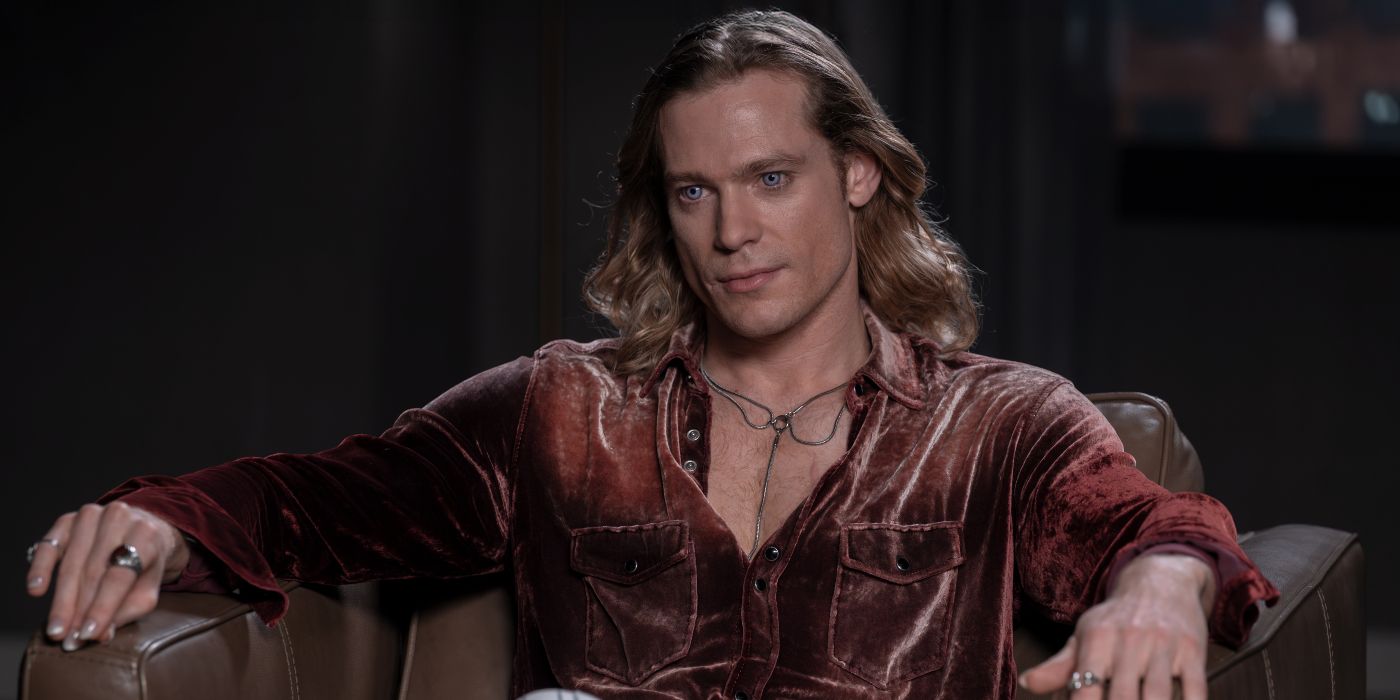
At last, Lestat sits down for the camera. He introduces himself by listing off everything that might or might not kill him (lines lifted straight from Anne Rice’s The Vampire Lestat novel): fire, the sun, fellow vampires with a grudge, and, for cheeky kicks and giggles, the band Jefferson Starship. Daniel interrogates Lestat as ruthlessly as expected. For his opening salvo, he eviscerates the less-than-poetic lyrics of “Long Face” and the sexual innuendo pervading “Black Licorice.” Ever the thespian, Lestat insists that every lyric holds meaning. They’re reflections on his life, a commentary on society’s existential crisis, or an amplification of his “performative vampire” persona.
Daniel refuses to let go of the childhood stutter question. Lounging nearby, the composed, in-control Gabriella looks mildly unsettled. Lestat’s irritation and repressed vulnerability escalate the more unrelenting Daniel becomes; the Pulitzer Prize winner is on the hunt for the secret truth he smells. Do Lestat’s excessive displays of “pure expression” double as an elaborate funeral? The Brat Prince either pretends to break — teary-eyed, wailing about how “no one cares” that he’s poured his soul into 40 concerts, then mocking Daniel for believing his impromptu performance — or uses his trusty armor to conceal legitimate hurt.
Once he’s danced around the subject enough to exhaust an Olympic athlete, Lestat does discuss his stammer as well as his “wolfkiller” infamy. He can’t help but cover the confessions in self-effacing sarcasm, of course, blaming both situations for his damaged psyche. There’s also the horrifying time his nine-year-old self watched teenage girls be burnt to death for supposed witchcraft. As for the events of his twenty-ninth year, those transformative moments warrant multiple flashbacks. Lestat, using a different surname and sporting a cloak lined with wolf fur, escapes his abusive family’s controlling grasp long enough to visit Paris. The glory that captivates his Auvergne heart isn’t the city’s wonders, but a gifted violinist named Nicolas “Nicky” de Lenfent (Joseph Potter).
The two childhood acquaintances reconnect in a tavern. Although Lestat’s “first love” and the subject of last week’s ballad, “Why Do I Have to Feel?,” is following his passion for music, he’s penniless, unappreciated, and insecure about his abilities. The present-day Lestat skips over their love affair’s intimate details, although he doesn’t deny Daniel’s claim that he mourned Nicky by burying himself “in the ground for a century.” He does, however, correct his interviewer on one detail: he keeps a music box not as a loving memento, but as a self-loathing reminder about his culpability in Nicky’s demise.
What about Lestat’s demise? For that, Daniel turns to “Your Biggest Fan,” a song written from the perspective of Lestat’s maker, Magnus (Damien Atkins). Lestat refuses to call Magnus abusive, so the rock ballad’s first half unfolds with a bone-chilling cognitive dissonance. The series casts the most horrifying moment of Lestat’s life as a playful satire about obsessively adoring fans, right down to Magnus gazing at Lestat from afar and lip-syncing the lyrics music video-style. The moment Lestat’s memories veer too close to the truth — Magnus dragging the courageous wolf-killer from his bed by the throat, dumping him into a room filled with corpses that resemble Lestat, psychologically tormenting him for a month before feeding from his crumpled form — abrupt silence takes over.
The crossover potential is still limitless.
Lestat jumps ahead to his and Nicky’s post-Magnus reunion. As much as Lestat savors Daniel’s flabbergasted reaction when he drops the bombshell that he turned his mother (who then followed her son to Paris), Lestat claims Gabriella didn’t survive past her “toddler” years. Suspicious, Daniel studies the woman who calls herself Sofia. He follows her telepathic suggestion and asks about the Great Conversion. Lestat turns up his nose at the idea of a vampire-dominated world. Instead, he circles back to Nicky. Lestat turns his first love at the other man’s distraught request, and against Gabriella’s warning. Nicky might have begged to spend eternity with his lover, but immortality means he’ll never escape his wounded sensitivity.
Nicky’s violin skills blossom. He joins the Théâtre des Vampires’ orchestra, but Armand disdains his frequent outbursts: his mind scattered, his heart overwhelmed by perfectionist self-hatred. The tragedy reaches its terrible conclusion once Nicky cuts off his own hand. Even though Lestat tries to make Nicky’s death as kind and comfortable as possible, he can’t strike the final blow. Armand holds Nicky down in the fireplace until he disintegrates into “nothingness.”
Finally, the Lestat of the 21st century reaches his breaking point. A bloody tear falls; he barely staves off a panic attack. Off-camera, he acknowledges how poorly the tour has sold and the battering his ego’s taken. He drives away, leaving even Gabriella behind. Daniel reviews the footage, and his ecstasy about this long-awaited breakthrough curdles into rage. None of the crew heard a word about Nicky because Lestat had telepathically communicated with Daniel. He’d bared an agonized part of his soul, but no recorded proof exists — just minutes of Lestat sitting in awkward silence.
As for Mr. de Pointe du Lac, there are zero tears in sight. He arrives at the Detroit coven’s lair and decapitates a vampire named Vester (Taylor Wint) in their front yard. Vester’s severed head expires before he can reveal Bruce’s (Damon Daunno) location. No matter — Louis strolls through the house and casually, effortlessly eliminates everyone who isn’t his target. Later that night, Bruce carries Baby Jenks (Ella Ballentine) over the threshold. The newlyweds find Louis waiting downstairs, smoking a cigarette and stripped down to a blood-stained white undershirt. He tears several bones out of Bruce’s spine to prevent his escape. Then, Louis reads aloud from Claudia’s (Bailey Bass) diary.
As Claudia’s graphic description of Bruce’s assault reaches his uncaring ears, the scene cuts back-and-forth between Louis’ revenge and Lestat hallucinating Magnus in his car. He can’t suppress the memory of his own abduction any longer; the torturous truth thunders free like water from a shattered dam. Lestat recites the same desperate, terrified prayer he did in the 18th century, when he was helpless against his merciless abuser. Deliverance never arrives for himself or his surrogate daughter. Claudia’s words describe her agonized despair from beyond the grave; Magnus pins Lestat to the floor and forces the screaming boy to consume his blood. Overwhelmed, the modern Lestat wrecks his car; Louis sets Claudia’s diary page and Bruce, by extension, on fire.
Louis visits that one specific diner to soak in the sight of Regina (Delainey Hayles), the waitress who resembles Claudia. And despite totaling his vehicle, Lestat still arrives at the concert venue. His music is reopening countless wounds, but confronting his muses might provide some cathartic healing. A vision of Nicky cheers him on from the audience while Magnus, and the real Gabriella, walk away. Elsewhere, Baby Jenks grieves Bruce, Daniel devours a victim in an alleyway, and Alex (Seamus Patterson) attends the same substance abuse recovery meeting as Arun — otherwise known as Armand.
The Vampire Lestat ](/tag/tv-show/the-vampire-lestat/) Lestat’s interview in Episode 3 delves deep into his past trauma, revealing painful memories and unhealed wounds.