Published Jun 5, 2026, 12:27 AM EDT
Diego Pineda has been a devout storyteller his whole life. He has self-published a fantasy novel and a book of short stories, and is actively working on publishing his second novel.
A lifelong fan of watching movies and talking about them endlessly, he writes reviews and analyses on his Instagram page dedicated to cinema, and occasionally on his blog. His favorite filmmakers are **Andrei Tarkovsky **and Charlie Chaplin. He loves modern Mexican cinema and thinks it’s tragically underappreciated.
Other interests of Diego’s include reading, gaming, roller coasters, writing reviews on his Letterboxd account (username: DPP_reviews), and going down rabbit holes of whatever topic he’s interested in at any given point.
Sign in to your Collider account
Science fiction is one of the most versatile genres at the disposal of TV creatives, one that allows them to tell exciting stories about modern society and the human condition through grand tales of technological advancement, space exploration, and futuristic speculation. Hard science fiction, however, is a category all of its own. The majority of sci-fi shows on Netflix are soft sci-fi, a subcategory of the genre that focuses on “soft” sciences like sociology and psychology. The main concerns of these shows are character development, thematic work, and emotion over scientific rigor. Hard sci-fi, on the other hand, is all about the “sci” part of the equation. These are shows focusing on “hard” sciences, scientific accuracy, natural laws, and an internal logic system.
Hard sci-fi series don’t need to be entirely true-to-life, but as long as scientific plausibility is prioritized as a key part of the narrative, they fall into this category. Thankfully for fans of these kinds of sci-fi stories, the streaming giant has a few precious gems lying in their catalog which approach perfection to an admirable degree. Whether it’s a serialized cult classic like ***Scavengers Reign ***or an anthology show like ***Black Mirror ***(which, we should note, isn’t hard sci-fi all the time), these shows should go straight into the Netflix watchlist of anyone who enjoys scientifically accurate science fiction. As intellectually rigorous as they may typically be, these shows also put heavy emphasis on actually being delectably entertaining.
After their infamously catastrophic final stretch as the showrunners of HBO’s Game of Thrones, **David Benioff **and **D. B. Weiss **were in desperate need of creating a show that would put a *very *strong band-aid on their reputation. Thankfully, ***3 Body Problem ***has thus far proven to be just that. It’s the third-ever adaptation of the Chinese novel series Remembrance of Earth’s Past, written by former computer engineer Liu Cixin, comprised of some of the best sci-fi books of the last 25 years. Named after a physics problem dealing with Newton’s laws of motion, it’s about a fateful decision made in 1960s China which reverberates into the present, where a group of scientists partners with a detective to confront an existential planetary threat.
The show is bolstered by a star-studded cast that includes the likes of **Eiza González **and Benedict Wong, but it’s its status as hard science fiction that really makes it stand out among the rest of Netflix’s sci-fi catalog. It’s a delightfully nerdy and admirably ambitious show, and even though it does start relying more and more on some fictional concepts as the story progresses, the majority of the narrative is anchored in actual science. This mixture of imaginative creative liberties and real physics provides a phenomenal balance that’s not often found in the streaming giant’s sci-fi shows, featuring concepts like quantum entanglement and — of course — the physics problem that gives the show its title.
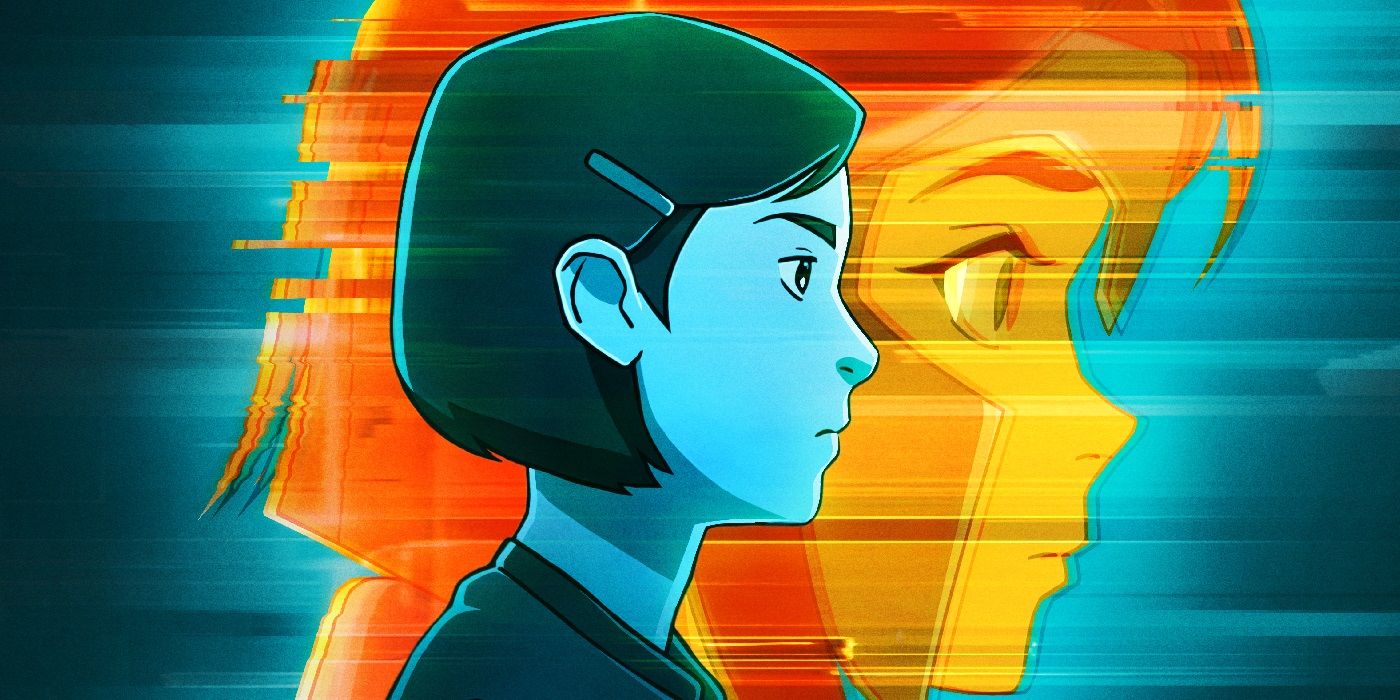
Created by Craig Silverstein and based on a series of short stories by Ken Liu, ***Pantheon ***is a cyberpunk thriller about Maddie, a young woman who starts getting messages from an unknown number that claims to be her deceased father. Trying to uncover the truth, she finds a larger conspiracy involving the singularity, a hypothetical event in which technological advancement accelerates beyond humanity’s control. It’s one of the best-ever animated series for adults, offering a uniquely engrossing exploration of a concept that’s abundantly common in science fiction about artificial intelligence. Three years after AMC+ canceled the show to claim a massive tax write-down amid internal restructuring, the series feels even more relevant and timely than it did back when it was still running.
Those who are fascinated by hard sci-fi that’s primarily about Artificial Intelligence **are bound to find Pantheon absolutely enthralling. Ambitious, mind-bending, and refreshingly intelligent in how it approaches its philosophically and scientifically complex ideas and themes, it’s some of the best science fiction animation that the 21st century has been treated to thus far. Though the show’s treatment of topics like consciousness definitely takes some creative leaps, it’s undeniably a hard sci-fi series grounded in theoretical science, one of the most fascinating portrayals of the singularity that the small screen has ever seen. It’s purely cerebral and incredibly well-written sci-fi.
Your answers point to the iconic sci-fi hero who shares your instincts, your values, and your particular way of facing the impossible.
You carry a weight most people would crumble under — the knowledge of what you’re capable of, and the burden of what you might have to become.
You lead with instinct, warmth, and an absolute refusal to accept a no-win scenario — because you’ve always believed there’s a third option nobody else has thought of yet.
You are the kind of person who holds the line when everyone else is losing faith — not because you’re fearless, but because giving up simply isn’t something you’re capable of.
You are not reckless, not grandiose, and not particularly interested in being anyone’s hero — you just refuse to stop when it matters.
You have been through fire that would break most people — and what came out the other side is something the world underestimates at its peril.
It’s easily one of the biggest tragedies of the last decade of televisual animation that ***Scavengers Reign ***was only allowed to run for one season. Though it was designed and originally pitched as a self-contained miniseries (one of the highest-rated sci-fi miniseries ever on IMDb), this avant-garde series about the crew of a stranded deep-space freighter surviving on a beautiful but dangerous planet had all the potential to run for at least a few more seasons. Alas, Max canceled it due to low viewership and high production costs after a single season, and though Netflix then acquired the series, they decided not to renew it.
Even still, *Scavengers Reign *has aged flawlessly as one of the best animated hard sci-fi shows of all time over the course of the last three years. Though a series entirely set on an alien planet may not initially seem like hard sci-fi on the surface, *Scavengers Reign *proves that the category is more of a spectrum. The show spends so much intellectual attention and scientific rigor on grounding its surreal alien ecology in plausible science rather than “space fantasy” that it undeniably counts as hard science fiction — and some of the most fascinating, entertaining, and best-written of the decade so far, at that.
*Black Mirror *is the modern-day spiritual successor to The Twilight Zone, a near-perfect sci-fi anthology series that reflects the intellectual and philosophical concerns of our modern hyper-technological society almost flawlessly. Like any anthology series, it definitely has had its fair share of duds throughout its seven seasons, but when a *Black Mirror *story hits, it hits hard. The show, which originally aired for two seasons on the British network Channel 4 before moving to Netflix, has offered some of the greatest anthology show episodes of the 21st century as a whole throughout its run. With a consistently star-studded cast and some incredible scripts, it’s the peak of modern anthology television.
Logically, *Black Mirror *hasn’t become one of the best sci-fi TV shows of all time by simply offering the same kind of story over and over again. Instead, it has shown tremendous creative versatility over the course of the last 15 years, which has obviously led it to explore very different sides of the sci-fi genre. As such, it falls into the soft sci-fi camp as often as it does hard sci-fi, but those who enjoy scientifically rigorous science fiction will find plenty of material to sink their teeth into here. When the show decides to ground its speculative technology in realistic advancements, it often results in absolutely riveting “what if?” storylines that would make **Rod Serling **proud.
Whether ***Dark ***is hard or soft science fiction is a topic of contention among sci-fi fans. After all, it’s not often that shows about time travel and parallel universes are able to ground their stories in any kind of believable or rigorous scientific system. However, one thing that isn’t really up for debate is that this is one of the best TV shows that Netflix has ever produced. Smart, impeccably and meticulously constructed, and delightfully mind-bending in ways that make keeping a notebook by one’s side while watching obligatory, it’s the peak of what the sci-fi thriller genre has to offer. It’s the type of sci-fi show that keeps you hooked from start to finish, a practically undeniable masterpiece that comes as close to perfection as the genre possibly can.
At first, *Dark *doesn’t really feel like hard sci-fi. It’s mostly quite character-driven, moody, emotional, and intensely atmospheric in a way that almost feels supernatural. But that’s precisely what makes it one of the most special hard sci-fi shows in Netflix’s catalog: It treats time travel and parallel universes like a self-contained and rigorously-constructed system, not magic. It’s coldly logical and extremely committed to causality, always framing its ideas in realistic scientific language — even when they’re mostly speculative. It’s proof of just how larger-than-life hard science fiction can feel without really deviating from what makes it unique, and it’s undoubtedly the best hard sci-fi show that those with a Netflix subscription can watch on the streaming giant’s platform.
Science Fiction
](/tag/science-fiction/)