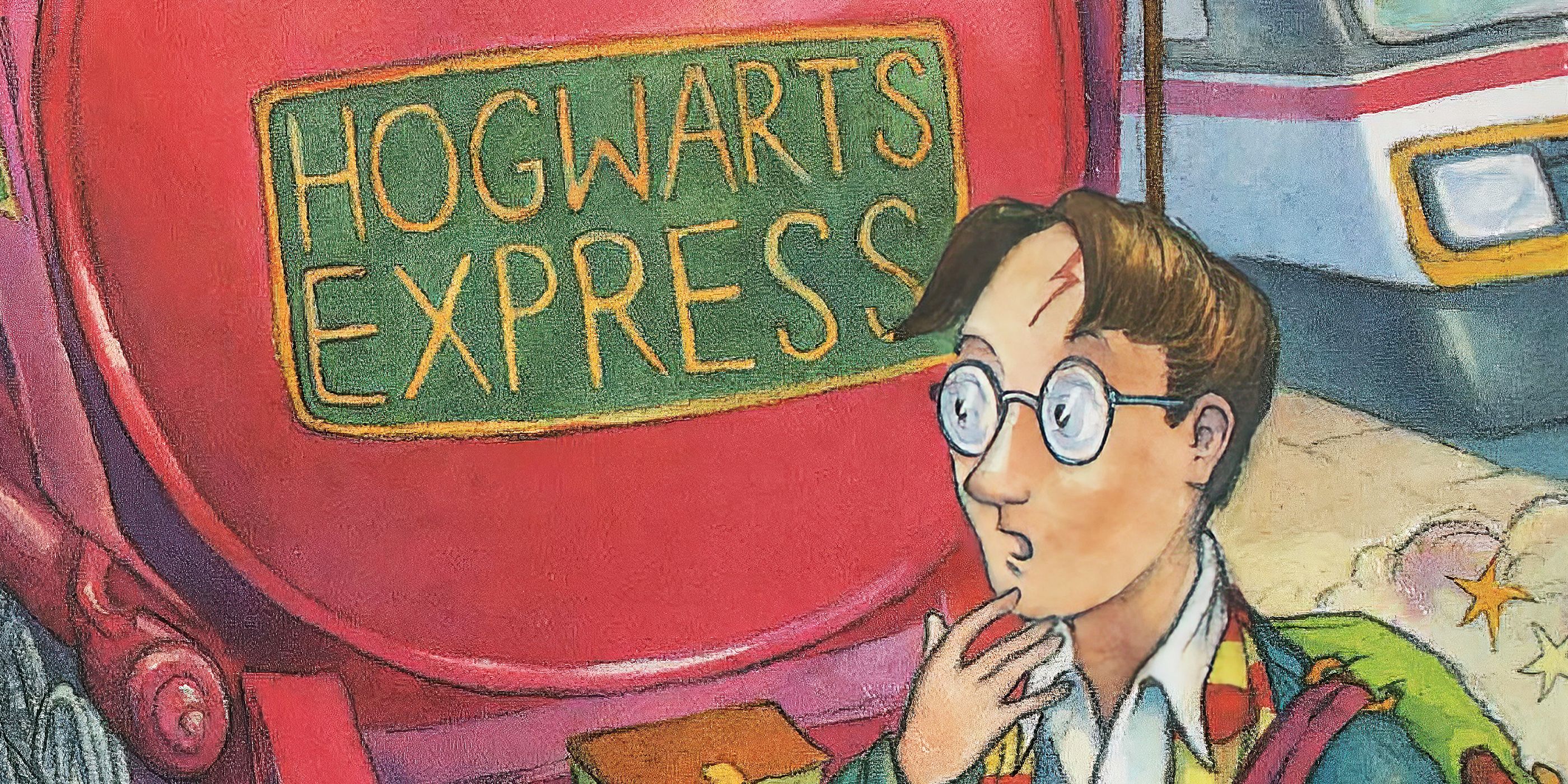
As controversial a figure as **J. K. Rowling **may deservedly be, there’s no denying that the Harry Potter series revolutionized not just the fantasy genre, but the publishing industry as a whole. Throughout seven incredible books that sold like the hottest of cakes, Rowling revitalized children’s and young adult fantasy in ways that were unheard of at the time. In all honesty, it seems unlike that a fantasy book series will ever have a pop-cultural impact of quite this scale ever again.
But as phenomenal as the *Harry Potter *books are, there are definitely stronger examples of fantasy literature out there that all those who love Harry’s adventures should check out at some point in their lives (given that they’re old enough to read them, of course). From YA fantasy much akin to Rowling’s masterful series to fantasy books that are most definitely not for the little readers of the family, these book sagas are even better than what the Wizarding World has to offer.
**Patrick Rothfuss **published ***The Name of the Wind ***in 2007 and its sequel, The Wise Man’s Fear, in 2011. Both books have been showered with praise over the years by creatives of the stature of George R. R. Martin, Ursula K. Le Guin, and Lin-Manuel Miranda over the years, and the praise is well-deserved. The series also comprises a short story and three novellas, but the novels are the main attraction here, and what an attraction they are.
The series has some of the most intricate worldbuilding and fascinating character work.
They’re both among the precious few fantasy books better than Harry Potter, with some of the most intricate worldbuilding and fascinating character work that the fantasy genre has seen at any point during the 21st century. Rothfuss is a magician with words, making it so that even when they’re at their most dense, ***The Name of the Wind *and The Wise Man’s Fear never feel tedious in the slightest. The only thing holding the series back is that a whopping 15 years after the publication of the second book, the long-overdue ***The Doors of Stone ***hasn’t yet been published, with there being no sign that it will see the light of day anytime soon.
Starting with The Lies of Locke Lamora, easily one of the greatest and most iconic fantasy novels of the 2000s, Scott Lynch’s ***Gentleman Bastard ***Sequence is one of those must-read series for those getting into fantasy books. It’s a masterclass in fantasy heist storytelling, balancing incredibly deep and charming world-building with some razor-sharp humor.
This is another example of a series that’s still unfinished, with Lynch having promised four more books and three novellas since 2013’s The Republic of Thieves. Still, the strengths of the material that fans already have are more than enough to make it a legendary book series. Philosophical or mythological depth isn’t really the point here; instead, it’s proof of just how entertaining character-driven fantasy stories can be when in the hands of someone with a voice as instantly endearing as Lynch’s.
The elephant in the room whenever talking about incomplete fantasy series always ends up leading back to George R. R. Martin’s A Song of Ice and Fire—and as far as fans are concerned, it probably always will. But despite also being held back in overall quality by the fact that it’s remained unfinished for 15 years, the tales of Westeros and Essos are fascinating enough that, even if the series never did end, it would still be one of the best in the history of fantasy literature.
From ***A Game of Thrones ***to A Dance with Dragons, each book in the series has something invaluable to offer. Though some may find its Medieval world-building somewhat slow, others love the series precisely because of that. It’s a monumental achievement of epic fantasy, bolstered by Martin’s mastery over narrative and world-building. This world feels incredibly lived-in and layered, and as a result, every event that occurs, whether it’s a massive battle or a small turning point in a character arc, can’t be anything less than satisfying.
The scores below reveal your true character. Your highest number is your match. Even a tie tells a story — the Fellowship was never made of simple people.
You carry something heavy — and you carry it alone, even when you don’t have to. You were not born for greatness, and that is precisely why greatness chose you. Your courage is not the roaring, sword-swinging kind; it is quiet, stubborn, and terrifying in its refusal to quit. The Ring weighs on you more than anyone can see, and still you walk toward the fire. That is not weakness. That is the rarest kind of strength there is.
You are, without question, the best of them. Not the most powerful, not the most celebrated — but the most essential. Your loyalty is not a trait; it is a force of nature. You would carry the person you love up the slopes of Mount Doom if it came to that, and we both know you’d do it without being asked. The world needs more people like you, and the world is lucky it has even one.
You were born to lead, and you have spent years running from it. The crown is yours by right, but you know better than anyone that right means nothing without the will and the worthiness to back it up. You are tempered by loss, shaped by long roads, and defined by a code of honour you hold to even when no one is watching. When you finally step forward, the world shifts. Because it was always waiting for you.
You have seen more than you let on, and you say less than you know — which is exactly as it should be. You are a catalyst: you do not fight the battles yourself, you ignite the people who can. Your wisdom comes not from books but from an age of watching what happens when it is ignored. You arrive precisely when you mean to, and your presence alone changes what is possible. A wizard is never late.
Graceful, perceptive, and almost preternaturally calm under pressure — you see things others miss and act before others react. You do not need to make a scene to be remarkable; your presence speaks for itself. You are loyal to those you choose to stand beside, and that choice is not made lightly. You have lived long enough to know that the most beautiful things in this world are also the most fragile, and that is why you fight to protect them.
You are loud, proud, and absolutely formidable — and beneath all of that is one of the most fiercely loyal hearts in Middle-earth. You don’t do anything by half measures. Your friendships are forged like iron, your grudges run as deep as mines, and your courage in battle is the kind that makes legends. You came into this fellowship suspicious of everyone and ended it willing to die for an elf. That is not a small thing. That is everything.
You think in centuries and act in absolutes. Order, dominion, control — not because you are cruel by nature, but because you have decided that the world left to itself always falls apart, and you are the only one with the vision and the will to hold it together. You were not always this. Something was lost, or taken, or betrayed, and the version of you that stands now is the answer to that wound. The tragedy is that you’re not entirely wrong — just entirely too far gone to course-correct.
You are a study in contradiction — pitiable and dangerous, cunning and broken, capable of both cruelty and something that once resembled love. You are defined by loss: of innocence, of self, of the one thing that gave your existence meaning. Two voices war inside you constantly, and the tragedy is that the better one sometimes wins, just not often enough, and never at the right moment. You are a warning, yes — but also a mirror. We are all a little Gollum, given the right ring and enough time.
Written by Canadian author Steven Erikson, the ***Malazan Book of the Fallen ***series may just be the single most ambitious fantasy series ever written, even if just for the sheer mind-boggling scale that Erikson achieves throughout these ten volumes. Following numerous characters across thousands of years and several continents, it’s a series whose scope is genuinely hard to fittingly describe.
Erikson’s worldbuilding is also far superior to Rowling’s, dropping the audience into a universe that already feels messily complete by the time we get to it with virtually no hand-holding. It’s a book series that has been compared to works like Homer’s ***The Iliad ***in terms of its almost-overwhelming scope, and there’s probably no bigger compliment that can be thrown at a fantasy book than comparing it to something like The Iliad.
It’s not really fair to compare the output of fantasy authors, since everyone has their own creative rhythm and that’s perfectly okay. Then again, it’s also not really fair for **Brandon Sanderson **to put most of his peers to shame by putting out one to two major novels every year, alongside at least a few novellas. Sanderson has written several excellent book series, one of his two most notorious being the ***Mistborn ***series.
The series consists of four eras, two of which have been completed (including some of the best fantasy books of the last 25 years), the third one being scheduled to kick off in 2028. Aside from having what many fans and critics hail as the best magic system in fantasy literature history, the *Mistborn *series feels so well-constructed that it’s almost hard to believe. Every rule, every plot point, and every emotional beat is of the utmost importance in this practically-perfect series.
Philip Pullman’s ***His Dark Materials ***trilogy has been marketed as YA fiction, but Pullman wrote with no target demographic in mind. As such, these are some of the most mature, philosophically complex, and downright controversial YA books in the genre’s history. If HBO’s adaptation became one of those fantasy shows that are perfect throughout, it’s because the source material was already so incredibly strong to begin with.
This series only grows darker and more admirably complex as it goes on.
Dealing with nuanced themes of religion, theology, and free will, this series only grows darker and more admirably complex as it goes on. Though it may be true that the philosophical concerns at times override narrative subtlety, Pullman’s mastery over those ideas is nevertheless so complete that those who love thought-provoking fantasy ought to consider this essential reading, no matter their age.
Beautifully character-driven and heavily inspired by elements and tropes from Arthurian legend, Robin Hobb’s ***Farseer ***Trilogy is some of the best character-driven epic fantasy that the ’90s ever saw. Even all these years later, it’s still a must-read, particularly for those intrigued by the idea of experiencing this fictional world through one of the most fascinating first-person perspectives in the genre’s history.
In a genre saturated with grand stories that can often feel a bit too epic and grand-scoped for their own good, Hobb demonstrated with her Farseer trilogy just how profoundly intimate fantasy can feel**. The level of psychological realism here is incredible, and though readers looking for faster-paced fantasy are better off looking elsewhere, those looking for a series that’s enrapturing purely through its creativity ought to check out Hobb’s work.
Few fantasy authors have ever been as legendary or as important to the genre as Ursula K. Le Guin. From 1968’s ***A Wizard of Earthsea ***(one of the best fantasy book masterpieces in history) to 2001’s The Other Wind, ***The Earthsea Cycle ***enchanted fantasy fans and critics the world over, which it continues to do today as one of the most influential fantasy book series in history.
With some of the most beautifully “archaic” and quasi-poetic prose that the genre has ever seen, Le Guin crafted a piece of philosophical fantasy at its purest and most enthralling. *The Earthsea Cycle *favors depth over scope in ways that are still delectably refreshing all these many years later, subverting traditional genre tropes in ways that were incredibly ahead of their time.
If any author is deserving of having two book series considered among the best ever written, it’s Brandon Sanderson. *Mistborn *is masterful, but there’s typically barely any disagreement that Sanderson’s magnum opus is The Stormlight Archive. Planned to consist of ten books set within Sanderson’s interconnected ***Cosmere ***universe (which *Mistborn *is also part of), the series thus far consists of five of the greatest high fantasy novels ever written.
From 2010’s ***The Way of Kings ***to 2024’s Wind and Truth, *The Stormlight Archive *has remained as the gold standard of 21st-century fantasy storytelling. Its huge scope feels refreshingly accessible, its characters feel psychologically realistic, and the way it balances scale and emotional payoff is masterful beyond description. Incredibly complex yet structurally airtight, it’s a fantasy book series on a tier all of its own.
When talking about the greatest fantasy book series in history, there’s really no question as to what the top spot has to be. All fantasy fans, whether they love the trilogy or not, have to admit that J. R. R. Tolkien’s ***Lord of the Rings ***trilogy is about as close to objective perfection as literature can possibly get. It’s the most important and groundbreaking piece of fantasy literature of the 20th century, and that’s without even mentioning that it’s also the source of three of the best fantasy movies of all time.
Initially developed by Tolkien as a simple sequel to The Hobbit, **The Lord of the Rings eventually started evolving into something far larger. Written as a single high fantasy epic but published in three volumes, it’s the peak of what a fantasy book series can achieve. Tolkien’s prose has no equal in this genre or any other, drawing influences from things like philology, world mythologies, Christianity, and previous fantasy classics. But while Tolkien wears his influences on his sleeve, what he created here was something of unprecedented creativity that still reads as a timeless masterpiece over 70 years later.
The Lord of the Rings: The Fellowship of the Ring ](/tag/the-lord-of-the-rings-the-fellowship-of-the-ring/)
](/tag/action/)
](/tag/fantasy/)
](/tag/adventure/)