Editor’s note: The following contains spoilers for The Testaments Season 1 finale.
In the season finale of the Hulu series*** The Testaments***, Daisy (Lucy Halliday), an undercover operative working with the resistance movement Mayday, decides to stay in the fight and create her own army in Gilead. While change might seem impossible for any one individual, they can find strength in each other because, like the episode says, “Nothing can be more powerful than a teenage girl” … except maybe a united front of them. And now that Agnes (Chase Infiniti) understands what’s at stake, along with how her lineage could play into things, it feels like things that have started bubbling to the surface will ultimately force a reckoning.
After watching the season, which has already proven to be a hit with a Season 2 pick-up, Collider got the opportunity to chat one-on-one with showrunner Bruce Miller, who also ran things for The Handmaid’s Tale. During the interview, he discussed going from being surrounded by red cloaks to being in a sea of purple, weaving June (Elisabeth Moss) into the story, how O-T Fagbenle influenced the casting of Infiniti, the importance of the kiss between Agnes and Becka (Mattea Conforti), what that last moment means, and the theme for Season 2.
**Collider: After so much time on The Handmaid’s Tale, was there an adjustment period for you to go from spending so much time on set staring at a sea of red cloaks, to then seeing purple everywhere? **
BRUCE MILLER: You do get used to a monochrome world, and I think that’s because that’s the way Gilead wants it to feel. They’re environment spheres, like the Handmaid’s sphere and the Aunt’s sphere, and they have their own colors. It’s just more dehumanizing by Gilead. For me, the period of adjustment was made a lot easier because I was there with Elisabeth Moss, who has been my creative partner for 10 years and has been at the center of every decision that we made on* The Handmaid’s Tale*. Television is a very big group project, but unlike the ones they had you do in school, this one works. We really do work together. So, I tried to bring as many of those people over, as well.
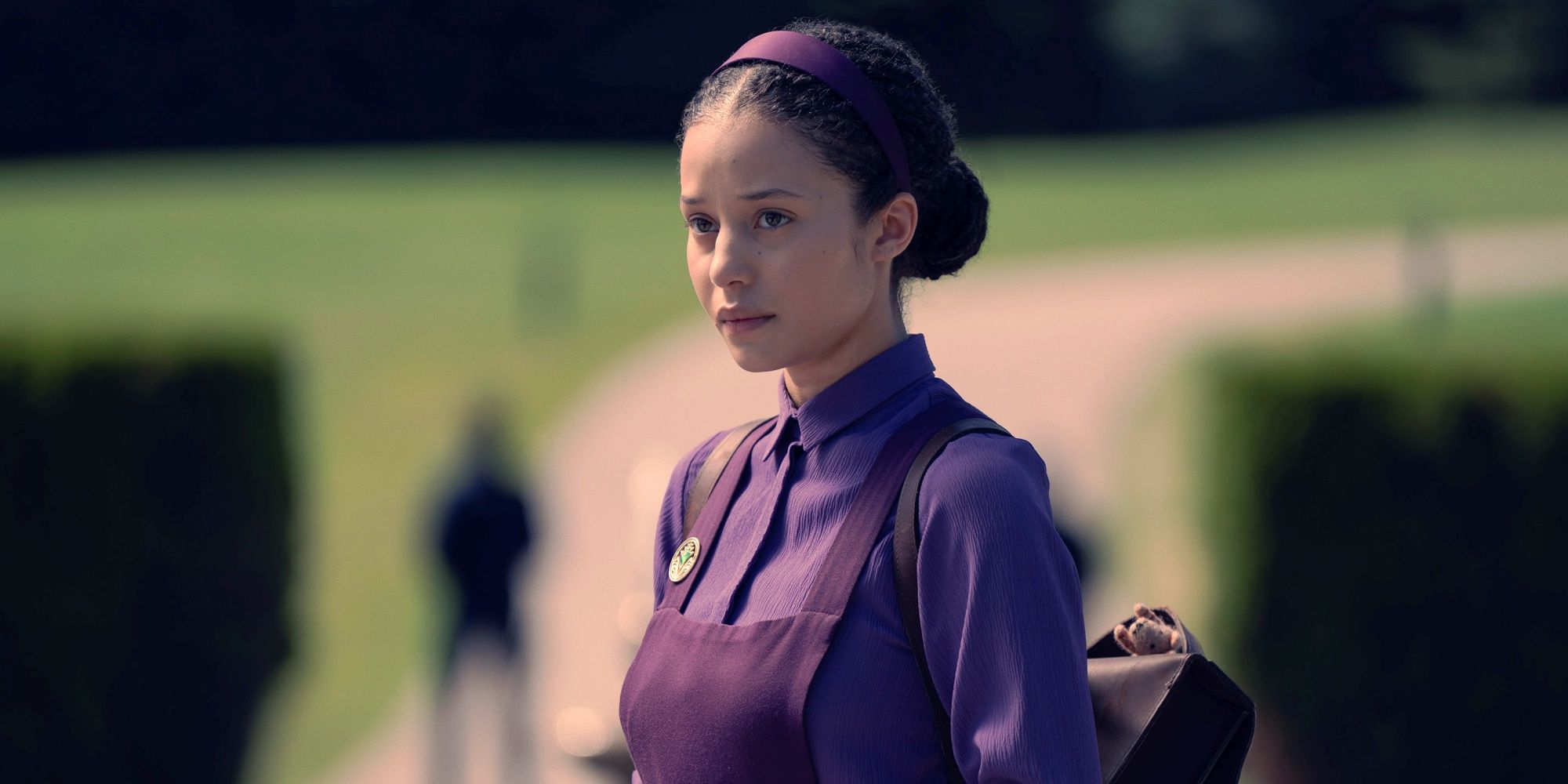
I felt like the best people to make a difference in the new version of this world are the ones that had established the first version. They know where to go and where new territory is. If you look at the production design and the wardrobe, and everything, it’s similar. It’s a sea of purple, but it’s a zillion shades of purple. All those girls individualize things in their own way, like with little things on their backpacks and stuff. It’s a sea of purple, where you can see Chase [Infiniti] and you can see Rowan [Blanchard], and they all pop out because it’s not just a sea of purple. They’re these young women, and no matter what you dress them in, you ain’t going to make them all the same.
‘The Testaments’ premieres April 8 on Hulu.
You’ve talked about how you didn’t just want to do Season 7 of The Handmaid’s Tale with this series. What was it like to figure out how to bring June into the story? Were there a lot of conversations about when and how the best times were to do that during the season, especially with how important it feels each time we do see June?
MILLER: There were a couple of concerns. The were story concerns because at the end of The Handmaid’s Tale, June certainly had some huge losses and huge successes, but there were some things, like her daughter’s fate, that were still out there. So, I felt like there was more of June’s story to tell. In the world of* The Testaments*, if you’re talking about Agnes, whose mother is a big character, whether or not you’ve ever seen The Handmaid’s Tale, she’s thinking about her mother and wants to know who her mother is.** I don’t think you have to see any of The Handmaid’s Tale to watch The Testaments.** It’s built that way. But I think that the character of June, of Agnes’ mother and the person who recruited Daisy, is a very important character in the story. That was really my feeling about when to see her.
But then, having all this backstory with that character, you can really make her so rich. What does it look like to fight a battle for that long and get to the point where you’ve tried and risked your life, over and over again? It’s worked, sort of. You’ve made progress, but you haven’t made the progress you wanted. What does that do to June? Seeing her as a character and how she’s grown, especially with how patient she is and still determined, says a lot about who Agnes is, and how she’s patient and determined. That’s what I really like about it. Every time you see June, you think it’s important because it’s having a huge influence on the characters we have now, not because you’re learning stuff about the past.
What was it like to then watch what Chase Infiniti did as June’s daughter without them even sharing screen time, at least yet? Were there times that you most clearly saw June in Agnes?
MILLER: Yes. Chase Infiniti is very gifted, but she works very hard. It comes from an incredible work ethic and being thoughtful. She’s well-trained, and she thinks about things like that. She was a Handmaid’s Tale fan and, as an actor and young woman, she just absorbed the Lizzie Moss of it all. I didn’t really have to push that at all. I was much more interested in what’s there that she’s learned along the way from other people. No matter what, we’ll see June there. But what are you looking at that’s from somebody else? The interesting thing is that there wasn’t a moment when I saw it. It happened before I met her. When Chase was recommended and became one of the people that we were going to consider, the casting pool looks at a thousand people and I look at 10. They make all the very smart decisions, so I take none of the credit. I don’t know who anybody is when they come in. Chase was brought to me, and she was excellent in the role. It was very easy to choose her to do that. But you don’t really know what they’re going to be like when they’re on-screen and what they’re going to be like, even more importantly, on set.
Television is a marriage. It’s not like a movie where you can get along for six weeks. In success, we’re hooked together. Fortunately, we had a secret weapon with O-T Fagbenle, who played Luke, Hannah’s father. He was working on Presumed Innocent and got to know Chase quite well, not only as an actor, but as a person on set. Knowing how important that is to me, when he heard she was reading for the part, he called me and said, “Run, don’t walk. She’s the real deal. She’s one of us. She’s someone who can work well in our working environment.” And he was absolutely right. There’s a certain kismet to the father picking the daughter, which I just found wonderful because O-T is a really great guy and very affectionate about Chase and the work that she does. These are grown women. They don’t need me or any other man to be proud of them, but they’re so impressive that it’s hard not to be proud of them. He was very impressed by her and thought she’d work out well. It’s hard not to say proud. I have a 21-year-old daughter, but I know that’s not my place.
“She has so much love for Agnes that she would never blame her,” says Mattea Conforti, when it comes to what Becka would do for her best friend.
**So much of this season is about the relationship between Agnes and Becka, Becka’s feelings for Agnes, and Agnes being caught between Becka and Garth. It’s just the biggest mess of a relationship. How did you approach finding the kiss between Agnes and Becka? What do you think that moment meant to Agnes? By the time we get to that point, so much has happened, to them and between them, so what was that like to figure out? **
MILLER: It’s a very interesting question. We work together as a writing staff on that kind of thing. I’m not a woman, so I have to rely on women to be very honest and express themselves to me. In this case, that definitely included Chase and Mattea [Conforti]. They worked on that scene with Mike Barker, who had also directed the first three episodes. Part of it was that they had already embodied the characters so much that when they got to that scene, you felt like, “Wow, they really know each other, and they know what this means to each of them.” It is a very complicated moment. You say, “Okay, am I just doing this for prurient reasons?” I’m a guy telling these two young women to kiss, so it certainly could be for that. So, I think** letting them find out what it meant and letting them find out how to do it was important.**
There are a zillion different kinds of kisses. Who goes forward first means a lot in this context, as does the reaction afterwards. I think the two women made it an acting moment about their friendship that really resonated beautifully. We had conversations with them both about people you knew in your life when you were that age. It’s beyond being in love with them. This is her best friend. The difference between how they feel about each other is slight, at best. There are things that Becka is starting to feel, but it’s not that far off from Agnes’ feelings. I had friends that I just wanted to give all my possessions to. At that age, you want to crawl inside someone else, you love them so much. That part of their relationship is so grounded and understandable in our world. And also, Gilead would kill them if they knew that they had kissed. A kiss can mean a thousand things to each of them. I thought that it was a good way for one friend to support another one. In this case, I think it did help her.
**I love that image of Agnes, Daisy and Shunammite walking down the hall together at the end. What can you say to tease what we could see with that trio in Season 2? What do you love most about the three of them, in particular? **
MILLER: They are astonishing actors. All three of them are very strong actors. Chase, through the whole last couple of episodes, is being pushed to the point of cracking, but stays so strong the whole time, right up until that moment. For me, what that does is show you that the first season has reached its point. It was an awakening. They have awakened. **Here they are, wide awake, walking down the hall. They’re not looking around. They’re direct. They’re good. They know where they’re going. **So, if the first season is about awakening, the second season is about identity.
It’s very common, or at least it felt very real, to have these teenagers get a little confidence before they are faced with problems. I like the idea that they’re going into it very confident. Daisy knows better, but the other two weren’t intending to bring Gilead down. They’re starting to feel themselves a little and feel their power a little. That moment at the end is striding towards identity. Even though they don’t really know, they think they know themselves completely, like you thought you knew yourself completely at 15. Striding towards the camera and disappearing is like, “Yeah, that’s nice. Keep going.” It’s the best thing that they have strength in each other, because that’s what Gilead didn’t want. And not only those three, they’ve got 25 other women they could trust in that circle.
The Testaments is available to stream on Hulu.
](/tag/tv-show/the-testaments/)
Science Fiction
](/tag/science-fiction/)