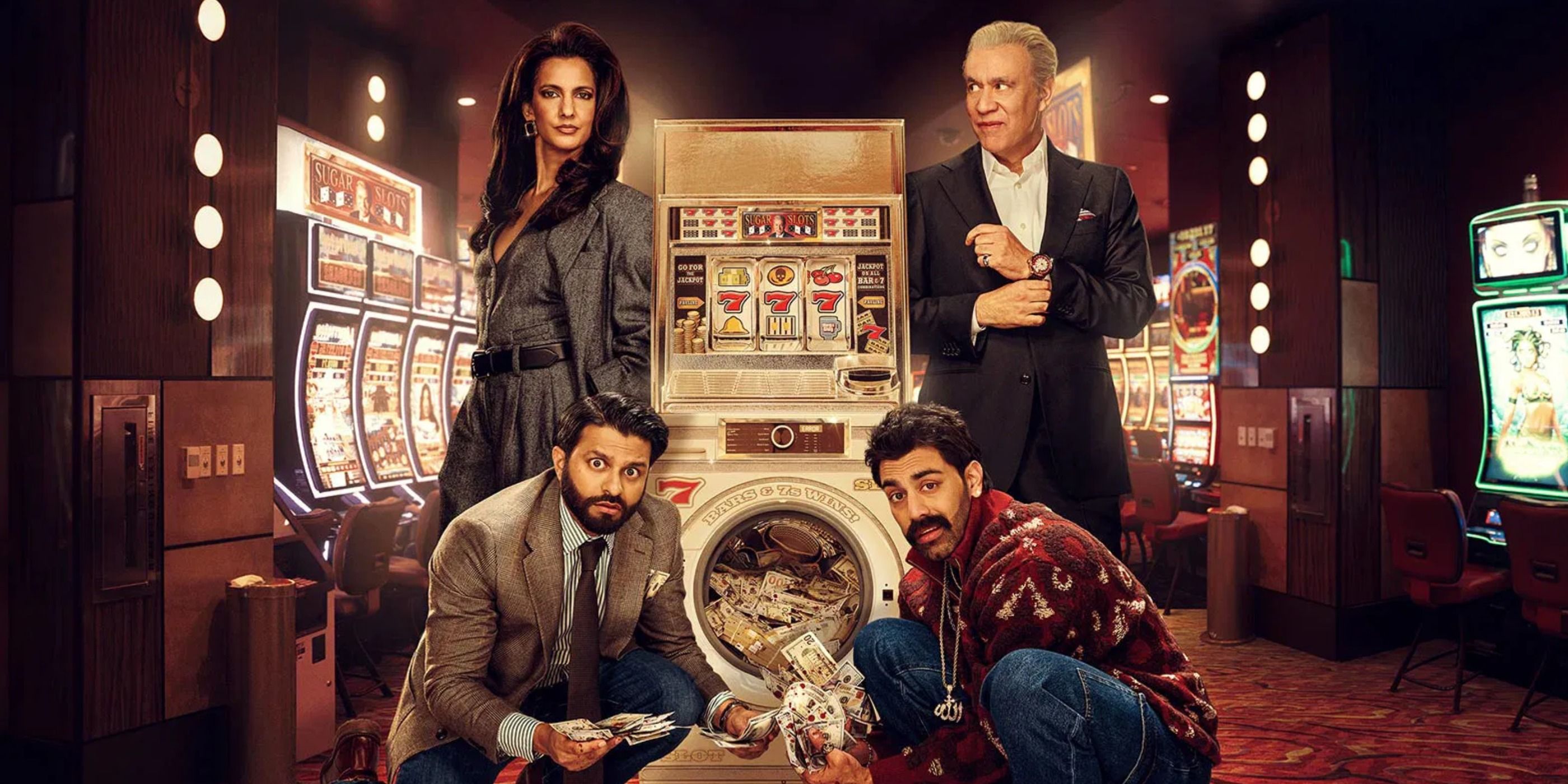
In the first few moments of Hulu’s highly anticipated Season 2 return of Deli Boys, the Dar brothers — led by Saagar Shaikh’s Raj and Asif Ali’s Mir — continue their absurd criminal education in one of the most fitting places ever: the family-owned and operated Pakistani bodega, ABC Deli. As they find themselves in the center of armed robbers wearing Benjamin Franklin (or, as they believe, “White Madea”) masks, Poorna Jagannathan’s Lucky Auntie starts yelling for the boys to hide their dirty cash, which is far from chump change. The Dar family has reached a level of “Porsche money in the laddus” (sphere-shaped desserts made of flour or lentils) stage of organized crime, which is absurdly laugh-out-loud and a testament to their shoddy organization. But while it’s a thrilling and funny opening, it also sets Season 2’s terms right away. These nepo babies may have inherited an empire with Lucky, but nobody said they knew how to run one.
It’s in those layers of the sophomore entry’s premiere, “Wealthy Boys,” that the season finds its rhythm. After teeing up some major one-disaster-after-another vibes last year, Season 2 lets the Dars swing wildly and hope something lands on the green. But for all its ambitions, the six-episode season is dramatically shorter than this world deserves, and at times, that compression leaves you wanting more room for these characters to expand. But the trade-off remains a tight, sharply paced theatrical binge that keeps its best instincts intact, with sharp jokes, excellent performances, and a very specific cultural heartbeat under all the criminal shenanigans.
While crime movies and TV shows often highlight the glamorous part of money laundering,* Deli Boys* play to the opposite with Mir, Raj, and Lucky now dealing with too much dirty money and no place to clean it. In just one year, DarCo has now become the top coke distributor in Philly, which sounds powerful until every sketchy criminal in the city starts to jack up their product. To keep the empire moving, the Dars turn to the ruthless and unpredictable Max Sugar (Fred Armisen), a casino mogul and money launderer whose connection with Lucky quickly becomes as complicated as the business itself.
Your answers have pointed to one action hero above all others. This is the person built to have your back — for better or considerably, spectacularly worse.
Your partner doesn’t talk much, doesn’t need to, and will have assessed every threat in your immediate environment before you’ve finished your first sentence. John Rambo is not a man of plans or politics — he is a force of nature shaped by survival, loyalty, and a capacity for endurance that goes beyond anything training can produce. He will not leave you behind. He has never left anyone behind who deserved to come home. What you get with Rambo is the most capable, most quietly ferocious partner imaginable — one who has been through things that would have broken anyone else, and who chose to keep going anyway. You’ll never need to ask if he has your back. You’ll just know.
Your partner will arrive perfectly dressed, perfectly briefed, and with a cover story so convincing it’ll take you a moment to remember what’s actually true. James Bond is the most professionally dangerous person in any room he enters — and the most disarmingly charming, which is the point. He operates in a world of layers, where nothing is what it appears and every advantage is used without apology. You’ll never be bored. You’ll occasionally be furious. But when it matters — when the mission is genuinely on the line and the margin for error has collapsed to nothing — Bond is exactly the partner you want. He has survived things that have no business being survivable. He does it with style. That is not nothing.
Your partner will know the history, the language, the cultural context, and exactly why the thing everyone else is ignoring is actually the most important thing in the room. Indiana Jones is brilliant, reckless, and occasionally impossible — but he is also one of the most resourceful, most genuinely knowledgeable partners you could find yourself beside. He approaches every situation with a scholar’s eye and a brawler’s instinct, which is an unusual combination and a remarkably effective one. He hates snakes and gets personally attached to objects of historical significance, both of which will slow you down at least once. It doesn’t matter. What Indy brings is irreplaceable — and the adventures you’ll have together will be the kind people write books about. Assuming you survive them.
Your partner was not supposed to be here. He does not have the right equipment, the right information, or anything approaching the right odds. He has a sarcastic remark and an absolute refusal to accept that the situation is as bad as it looks. John McClane is the greatest accidental hero in the history of action cinema — a man whose superpower is stubbornness, whose contingency plan is improvisation, and whose capacity to absorb punishment and keep moving would be alarming if it weren’t so useful. He will complain the entire time. He will make it significantly more chaotic than it needed to be. And he will absolutely, unconditionally, without question come through when it counts. Yippee-ki-yay.
Your partner has already run seventeen scenarios by the time you’ve finished reading the briefing, and the plan he’s settled on involves at least two things that should be physically impossible. Ethan Hunt operates at the absolute edge of human capability — technically, physically, and intellectually — and he brings the same relentless precision to protecting his partners that he brings to dismantling organisations that shouldn’t exist. He is not easy to know and he will never fully tell you everything. But he will carry the weight of the mission so completely, so absolutely, that your job is simply to trust him — and the remarkable thing is that trusting him always turns out to be the right call. The mission will be impossible. He will complete it anyway.
Naturally, the Abdullah Saeed-created show, executive-produced by Jenni Konner and Michelle Nader, piles on the headaches with a ton of charm, making every episode absolutely hilarious from start to finish. After what happened to their baba (father) last season, Raj is consumed by revenge against Ahmad Uncle (Brian George), Mir becomes obsessed with pushing DarCo into more respectable territory through a golf course deal, and Lucky is carefully managing the push-and-pull between the boys and her growing dynamic with Max. Meanwhile, the very matter-of-fact and super anal-retentive, Philly D.A. Andrew Chadwater (Andrew Rannells) sees the Dars as his ticket to winning the mayoral election, turning their coke business into something much bigger than the Dar family’s growing pains.
What keeps this shorter season so engaging is also how personal all of this feels as the boys continue to mistake impulse for strategy — a rookie move for two boys just trying to figure out their place in this world. But between Max being basically another partner in the DarCo trade and Chadwater turning the family’s drug business into his own campaign target, Season 2 keeps finding new ways to make success for Mir, Raj, and Lucky feel like its own punishment across its near bite-sized 30-minute episodes.
One of the best things about Deli Boys Season 2 is how nobody ever plays their role too broadly, even when the situations themselves become absurd. Jagannathan, Ali, and Shaikh make the show’s comedy hit so hard again this year, which is exactly why so many scenes still feel emotionally real beneath the craziness. But Jagannathan remains Deli Boys’ biggest weapon — and a legit queen at every moment, balancing different tones at once. What she does this season is absolutely striking, especially as she never forces the comedy too. Instead, Lucky’s reactions do the work, whether it’s a glare, a deadpan pause, or the sheer exhaustion in her voice whenever Mir and Raj start spiraling into more bad ideas.
Meanwhile, Ali and Shaikh continue to carry the emotional center of the series with a lot of heart and laughs. Ali gives his character Mir an anxious ambition that feels like one bad decision away from collapse, while Shaikh’s Raj leans harder on his emotional volatility and wounded pride after last season’s events involving Ahmad Uncle. In what is also pure joy to watch this season, the two still feel completely believable as brothers and give the show a fun, charming buddy crime comedy vibe.
Joining the cast this year is also Saturday Night Live legend, Armisen, who makes Max Sugar feel like he was always supposed to exist in this world. His performance is also weirdly unsettling in the best way, bordering on calm, soft-spoken, and hilarious without ever chasing the joke too hard. He gives Max this unpredictable quality where every scene feels slightly dangerous, especially opposite Jagannathan, whose chemistry with him becomes** one of the season’s greatest surprises**.
Meanwhile, the supporting cast gets some fun-filled moments to shine, like Rannells, who is just so funny as Chadwater with a painfully self-serious energy that makes every interaction feel a little awkward in the funniest way. The nuances he brings to his role are enjoyably humorous, especially as he has a weird fixation on milk. But one of the biggest standouts for the season is also Kumail Nanjiani, who arrives midway through the season and immediately threatens to steal entire scenes through pure charisma alone and a romantic Bollywood glow. However, as good as he is, it’s a shame he’s only featured in one central episode and for a few seconds a bit later, which feels like a disservice to the writing attempting to build bigger arcs for this world.
For all the things* Deli Boys* does right, the real weakness is that the show is only six episodes long this year compared to its 10-episode order last season. For a show that is prestigious in its realm of top-tier comedy, the shorter season means certain supporting characters and storylines don’t get the room they deserve, and it’s frustrating because the issue isn’t rooted in writing, but rather studio decisions that forcibly shrink a show that clearly has more texture and bite.
As noted earlier, Nanjiani’s role as Danyal is probably the clearest example of that frustration. He arrives midway through the season, instantly stealing scenes through his charisma and weird little line deliveries, only for the show to pull him away as quickly as it introduces him. This compression is also felt with Tan France’s return as Zubair, the South London gang leader, hunting the Dars, as well as Raj’s wife Nandika, played by Amita Rao, who manages his newfound fame as this Luigi Mangione-type figure. But for all the potential these characters build into the series through solid writing, even **Lilly Singh **as Aisha, Ali’s (Shahjehan Khan) wife, who has a hilarious fascination with Raj, is a loss for what we don’t get to see, as the path that arc was heading down would have brought about more laughs.
A final twist sets up Season 2 of this Hulu comedy series.
That said, what Deli Boys accomplishes in those six episodes is still wildly impressive, with every scene delivering laughs and excitement. The writing remains incredibly sharp at balancing chaos with emotional grounding, especially as the season juggles the Dars’ growing empire and their constant inability to make a normal decision. While the show keeps all those moving pieces from collapsing into noise, it’s a joy to see how every episode escalates naturally and packs a punch for zany, often slapstick comedy.
Moreover, Deli Boys manages to get smarter about how Philly is used, too. The city feels grimier and more lived-in this time around, especially as the Dars move between their drug empire’s points of interest. If you watch closely enough as well, an underlying uncertainty and element of surprise gives the comedy a sharper edge, especially getting into the Season 2 finale’s cliffhanger. But what continues to really separate the show from other crime comedies is its specificity. Urdu still flies naturally through conversations as the culturally Pakistani details between food, clothing, family guilt, and insults remain woven directly into the DNA of the show instead of sitting on top of it like a cake topper.
Even with its tighter runtime and a few character arcs that deserved more, **Deli Boys Season 2 remains one of the funniest and most distinctive shows to come out of streaming. The cast is stellar, the writing stays sharp, and the season’s electrifying circus keeps getting better the messier things become. By the time the finale rolls around, it’s clear Deli Boys still has plenty left to explore for Season 3 — and I would gladly spend another weekend watching the Dars make terrible decisions trying to survive it.
Deli Boys Season 2 premieres May 28 on Hulu.
](/tag/tv-show/deli-boys/) Hulu’s sharpest crime comedy takes even bigger swings.