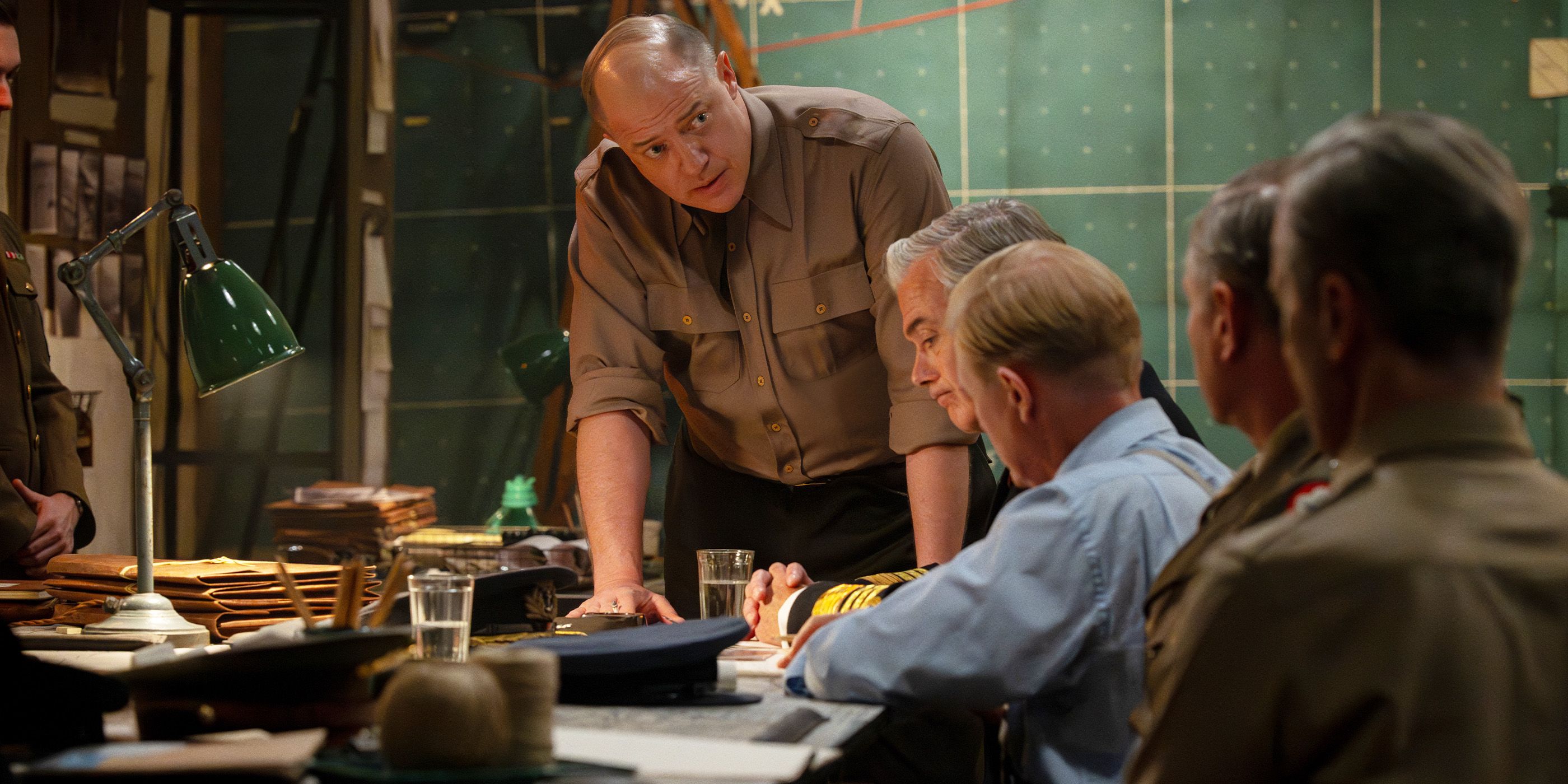
One could argue that World War II has been pretty much mined and exhausted when it comes to new angles and compelling narratives on film. Well, if you believe that, you’d best think again because one of the most intriguing new takes on the Second World War arrives in theaters in just one week, and it’s going to be your dad’s new favorite war movie. Heck, it might even be yours, because it’s got a cast to die for.
Pressure stars Brendan Fraser as General Dwight D. Eisenhower, with Andrew Scott leading the film as British meteorologist Captain James Stagg. The film is set in the 72 hours before D-Day, and it follows the build-up to the Allied invasion of Normandy, as Eisenhower and Stagg face an almost impossible question of when to launch the largest seaborne invasion in history, or to delay it and risk losing the chance of surprising the Nazis altogether. The final say comes down to Eisenhower, so will his decision mean a clear victory across Europe, or will we all wake up tomorrow speaking German? There’s only one way to find out, and that’s to head to the multiplex on May 29.
Your answers have pointed to one Oscar Best Picture winner above all others. This is the film that was made for the way your mind works.
You are drawn to films that operate on multiple levels simultaneously — that begin in one genre and quietly, brilliantly migrate into another. Bong Joon-ho’s Parasite is a film about class, desire, and the architecture of inequality that manages to be darkly funny, deeply suspenseful, and genuinely shocking across a single extraordinary running time. Your instinct is for cinema that hides its true intentions until the moment it’s ready to reveal them. Parasite is exactly that — a film that rewards close attention and punishes assumptions, right up to its devastating final image.
You want it all — and this film gives you all of it. The Daniels’ Everything Everywhere All at Once is one of the most maximalist films ever made: action comedy, multiverse sci-fi, family drama, existential crisis, and a genuinely earned emotional core that sneaks up on you amid the chaos. You are someone who responds to ambition, who doesn’t want cinema to choose between being entertaining and being meaningful. This film refuses that choice entirely. It is overwhelming by design, and its overwhelming nature is precisely the point — because the feeling of being crushed by infinite possibility is exactly what it’s about.
You are drawn to cinema on a grand scale — films that understand history not as a backdrop but as a force, and that place their characters inside that force and watch what happens. Christopher Nolan’s Oppenheimer is a film about the terrifying gap between what we can do and what we should do, told with the full weight of one of the most consequential moments in human history behind it. You want your films to feel important without feeling self-important — to earn their ambition through sheer craft and the gravity of their subject. Oppenheimer does exactly that. It is enormous, complicated, and refuses easy comfort.
You are drawn to films that foreground their own construction — that make the how of the filmmaking part of the what it’s about. Alejandro González Iñárritu’s Birdman, shot to appear as a single continuous take, is cinema examining itself through the cracked mirror of a fading actor’s ego. You respond to formal daring, to the feeling that a film is doing something that probably shouldn’t be possible. Michael Keaton’s performance and Emmanuel Lubezki’s restless camera create something genuinely unlike anything else — a film that is simultaneously about creativity, relevance, self-destruction, and the impossibility of ever truly knowing if your work means anything at all.
You are drawn to cinema that trusts silence, that refuses to explain itself, and that treats dread as a form of meaning. The Coen Brothers’ No Country for Old Men is a film about the arrival of a new kind of evil — implacable, arbitrary, and utterly indifferent to the moral frameworks we use to make sense of the world. It is one of the most formally controlled films ever made, and its controlled restraint is what makes it so terrifying. You want your films to haunt you, not comfort you. You are not interested in resolution if resolution would be dishonest. No Country for Old Men is honest in a way that most cinema never dares to be.
The film is directed by Anthony Maras, who previously took charge of Hotel Mumbai, and is based on David Haig’s stage play of the same name. Alongside Scott and Fraser, Eisenhower’s aide **Kay Summersby **is played by Kerry Condon (F1), Damian Lewis (Homeland) will play legendary British Field Marshal Bernard Montgomery; Henry Ashton (A Knight of the Seven Kingdoms) portrays John Eisenhower, the general’s son, who served alongside his father; and Con O’Neill (Our Flag Means Death) stars as Trafford Leigh-Mallory, the air commander of the Normandy invasion, while Stagg’s rival in the field of meteorology, **Irving Krick, **is played by Chris Messina The film also stars Daniel Quinn-Toyes (Sunny Dancer), Toby Williams (Vanity Fair), and Max Croes (A Working Man).
The film’s screenplay was penned by Haig and Maras. It is a production of Working Title Films and Studiocanal, and will be distributed in the United States by Focus Features. Stay tuned to Collider for more updates and coverage of Pressure, which is coming to theaters on May 29.
](/tag/thriller/)
](/tag/history/)
Marshall Bernard Montgomery