Thomas Randolph is a dynamic and multi-talented writer with a background in music and a deep love for all things history and sci-fi. With roots in Houston, Texas, Thomas received a bachelor’s degree in music focusing on classical guitar performance. Music has been a part of Thomas’ life since childhood, and has been a constant companion and creative outlet. In addition to music, Thomas has always had a passion for writing as a form of creative expression, and he enjoys writing about music, fantasy tabletop rpgs, and of course, movies.
Thomas’ movie taste began to form with sci-fi action classics like The Terminator and Aliens, and he has never left that love behind. In addition, Thomas has an affinity for historical drama, historical fiction, westerns, and horror. Above all, he is a lover of compelling and powerful cinema of any genre, always tending toward more bleak and challenging films.
Thomas also runs his own YouTube channel primarily focused on nuclear weapons history called “Doomed to Repeat”.
On June 6th, 1944, 160,000 Allied soldiers landed on occupied France via parachute, glider, and watercraft, in order to liberate Western Europe from the Nazis. It is an event that is almost legendary in its scale and consequences, so it is little wonder that filmmakers have visited the subject time and again. From *The Longest Day *in 1962 to Steven Spielberg’s brilliant opening scene in Saving Private Ryan, directors have used the beach landings to show heroism and bravery against harrowing odds.
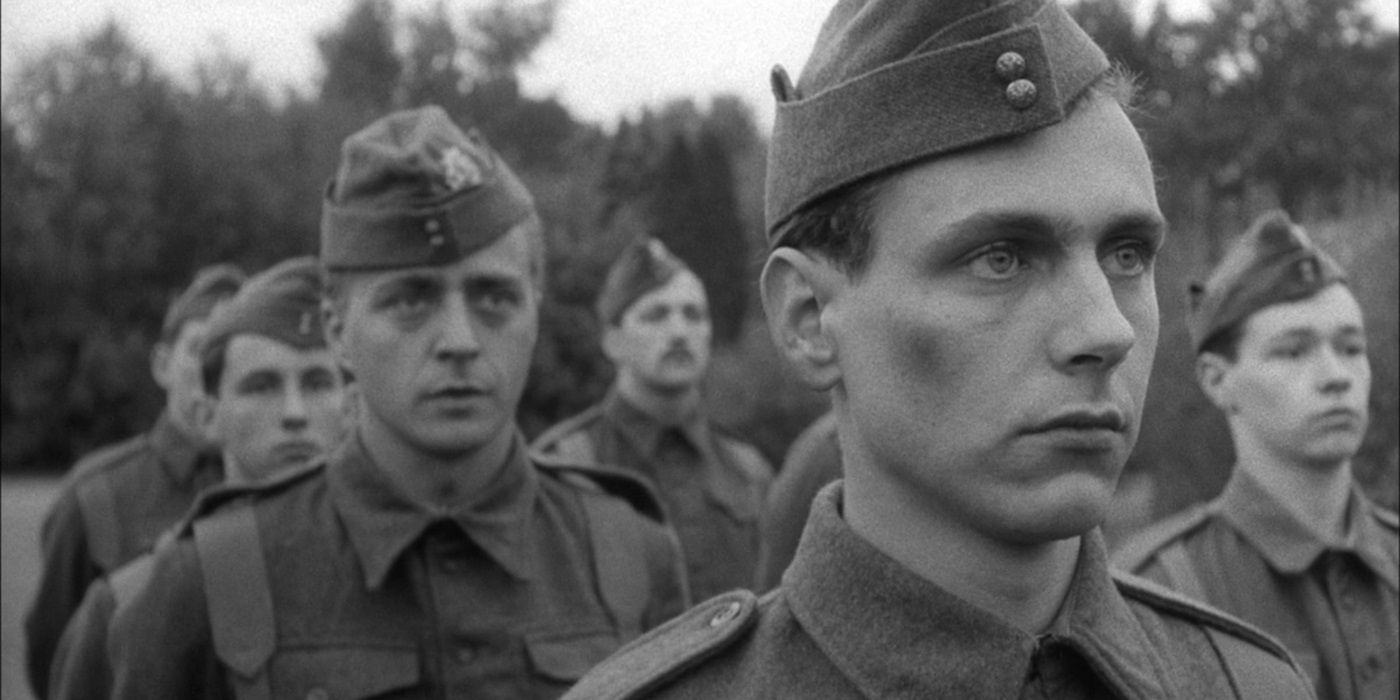
While there certainly were heroes on that terrible day, those stories were not what interested British director Stuart Cooper when he set out to make his own D-Day film, 1975’s *Overlord. *Instead, Cooper delivers a more intimate, grittier, and tragically accurate historical fiction, one that will stay with audiences long after the credits roll. The name *Overlord *actually comes from the Allied codename for the invasion of Normandy during World War II. The film sets this expectation for the big day from the start, with the name blatantly informing the audience about what the movie is leading up to.
In stark contrast to the gravity and size of Operation Overlord, audiences are introduced to an “everyman” recruit named Thomas Beddows (Bryan Stirner). Beddows is an Englishman who joins up with the British Army, undergoes basic training, and anxiously awaits his assignment in the war. The length and breadth of the film is spent, not with Beddows taking cover from German guns, but rather, taking scoldings from drill sergeants. Beddows does all the things viewers expect during the first quarter of a typical war film; he trains, he talks about life after the war with his mates, and he even dances with a woman and plans to take her out on a date. Only in *Overlord, *this period of pre-combat makes up the bulk of the film.
Instead of intricately shot combat scenes with hundreds of extras, Cooper relies heavily on archival footage of actual soldiers and implements of war. Intercut with the “live action” shots are real scenes of bombings, Nazi rallies, and troops and tanks on the march — adding to the realistic nature of the movie. In order to avoid visual whiplash, Cooper actually tracked down period-correct camera lenses from the 1930s and 1940s, so the look of his new footage would match the stock films. All of these scenes are woven seamlessly throughout the narrative, with Beddow’s troubled dreams being particularly wrought with grizzly visions of war. This gives *Overlord *an authentic look that also feels quite dreamy and nostalgic, making the events portrayed all the more sad to watch.
Your answers have pointed to one Oscar Best Picture winner above all others. This is the film that was made for the way your mind works.
You are drawn to films that operate on multiple levels simultaneously — that begin in one genre and quietly, brilliantly migrate into another. Bong Joon-ho’s Parasite is a film about class, desire, and the architecture of inequality that manages to be darkly funny, deeply suspenseful, and genuinely shocking across a single extraordinary running time. Your instinct is for cinema that hides its true intentions until the moment it’s ready to reveal them. Parasite is exactly that — a film that rewards close attention and punishes assumptions, right up to its devastating final image.
You want it all — and this film gives you all of it. The Daniels’ Everything Everywhere All at Once is one of the most maximalist films ever made: action comedy, multiverse sci-fi, family drama, existential crisis, and a genuinely earned emotional core that sneaks up on you amid the chaos. You are someone who responds to ambition, who doesn’t want cinema to choose between being entertaining and being meaningful. This film refuses that choice entirely. It is overwhelming by design, and its overwhelming nature is precisely the point — because the feeling of being crushed by infinite possibility is exactly what it’s about.
You are drawn to cinema on a grand scale — films that understand history not as a backdrop but as a force, and that place their characters inside that force and watch what happens. Christopher Nolan’s Oppenheimer is a film about the terrifying gap between what we can do and what we should do, told with the full weight of one of the most consequential moments in human history behind it. You want your films to feel important without feeling self-important — to earn their ambition through sheer craft and the gravity of their subject. Oppenheimer does exactly that. It is enormous, complicated, and refuses easy comfort.
You are drawn to films that foreground their own construction — that make the how of the filmmaking part of the what it’s about. Alejandro González Iñárritu’s Birdman, shot to appear as a single continuous take, is cinema examining itself through the cracked mirror of a fading actor’s ego. You respond to formal daring, to the feeling that a film is doing something that probably shouldn’t be possible. Michael Keaton’s performance and Emmanuel Lubezki’s restless camera create something genuinely unlike anything else — a film that is simultaneously about creativity, relevance, self-destruction, and the impossibility of ever truly knowing if your work means anything at all.
You are drawn to cinema that trusts silence, that refuses to explain itself, and that treats dread as a form of meaning. The Coen Brothers’ No Country for Old Men is a film about the arrival of a new kind of evil — implacable, arbitrary, and utterly indifferent to the moral frameworks we use to make sense of the world. It is one of the most formally controlled films ever made, and its controlled restraint is what makes it so terrifying. You want your films to haunt you, not comfort you. You are not interested in resolution if resolution would be dishonest. No Country for Old Men is honest in a way that most cinema never dares to be.
It is impossible to talk about *Overlord *without discussing its infamous ending, so anyone who would like to watch the film first should be aware of spoilers coming up. As mentioned above, most movies about D-Day give audiences a sort of hero to follow up the beach. Hundreds of soldiers die around our hero, but he always makes it, giving viewers a sort of proxy through the battle. But in *Overlord, *after spending more than an hour and a half with Private Beddows, the young man is shot in the head before he even steps off the landing craft. This scene is an absolute gut punch, leaving the viewer feeling completely devastated, if not a bit numb. Much in the same way that ***The Deer Hunter ***shows the deep friendship of the four leads before throwing them into The Vietnam War, Cooper gives us a portrait of a decent young man with a whole life ahead of him before unceremoniously cutting him down in the final minutes of the movie. As deeply depressing as it is, this is just what *Overlord *is trying to accomplish. Thomas Beddows is just one of the literal millions of young men across the world who lost their lives similarly during that terrible war.
Stuart Cooper’s *Overlord *is an epic of a very different sort than other war films. It does not dazzle with its effects, and it does not show the hell of battle through the eyes of a hero. Instead, *Overlord *chooses to represent the ordinary, almost forgotten soldier that falls without a word. Every extra in a war movie that dies in the background represents another Thomas Beddows, and *Overlord *was made for those lost lives. Everybody ought to see this film at least once, and remember that war is not fought by mythological heroes, but by ordinary people.
](/tag/movie/overlord-2018/)
](/tag/history/)
Christopher Hudson