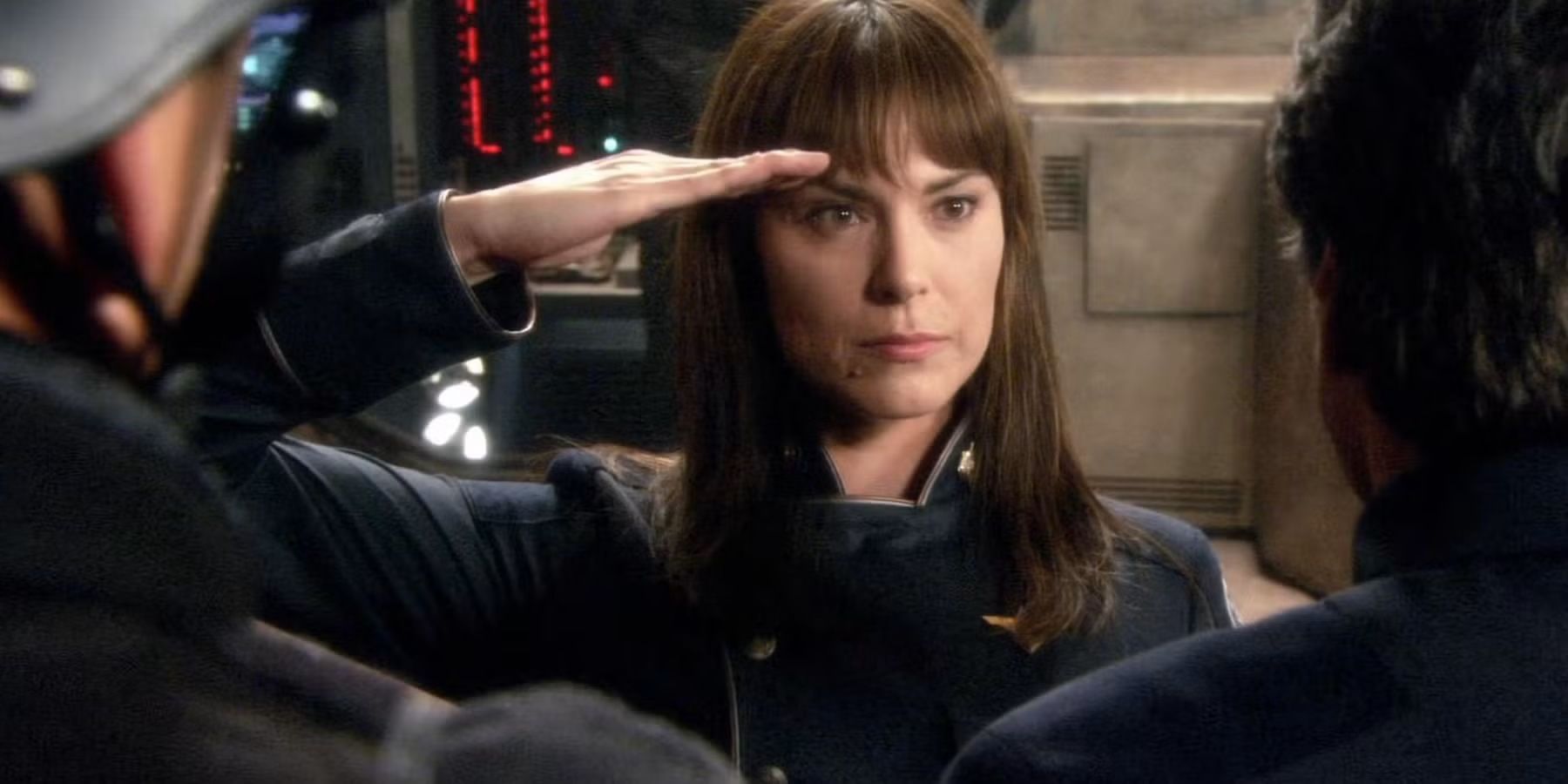
Black Mirror*** **is often held up as the gold standard of science fiction television because it presents alternative, speculative, and hypothetical ways in which technology could change the nature of reality. Although there are many brilliant installments in the Black Mirror series, it’s a series that has rarely been able to follow up on its stories, meaning that there is a limit to how deep they can get. When looking at the shows that were truly revolutionary, Battlestar Galactica *****was unprecedented for what it did on television **to warrant respect for the sci-fi genre. It wasn’t just a masterful reboot of a cult classic show but a timely work of political and philosophical storytelling that asked important questions about the future of humanity.
The original *Battlestar Galactica *was little more than a cheap rip-off of Star Wars, which even prompted **George Lucas **to sue its creators due to the similarities. **The modern *****Battlestar Galactica *****revamped the premise **after a miniseries aired that set up the stark new reality for the show. In the aftermath of a devastating attack on the human race, survivors have been engaged in a seemingly never-ending war against a cybernetic race known as the “Cylons.” Although an entire civilization has survived on a fleet of vessels that search for the safety of Earth, it is still vulnerable to danger, especially when the Cylons are able to impersonate humans and infiltrate the inner command circle. There may have been some doubts about whether or not *Battlestar Galactica *would resonate with an audience beyond those who had followed the original show, but the debut episode “33” put those concerns to an end by delivering one of the most riveting hours of television ever.
The genius of *Battlestar Galactica *was that it wasn’t centered on humanity discovering new technology or alien races, but set after these breakthroughs had already become an accepted part of reality. ***Battlestar Galactica *****felt like it had a lived-in universe **because it explored the complex political makeup of humanity that had been formed out of pure survivalism, yet wasn’t sustainable as a long-term society. The notion of an overpowered military clashing with a temperamental government and a radicalized body of civilians was particularly relevant when the show began airing shortly after 9/11, as it was one of the few television shows that understood the anxieties that came with being in the midst of the war. The debate that *Battlestar Galactica *had was one that America was in the midst of. The show questioned if the preservation of one’s ideals was worth potential extermination.
Your answers point to the world your instincts were built for. This is the universe your temperament, your survival instincts, and your particular brand of stubbornness were made for.
You took the red pill a long time ago — probably before anyone offered it to you. You’re a systems thinker who can’t help but notice the seams in things.
The wasteland doesn’t reward the clever or the well-connected — it rewards those who are hard to kill and harder to break. That’s you.
You’d survive here because you know how to exist in moral grey areas without losing yourself completely.
Arrakis is the most hostile environment in the known universe — and you are precisely the kind of person it rewards.
The galaxy far, far away is vast, loud, and in a constant state of violent political upheaval — and you wouldn’t have it any other way.
Battlestar Galactica is as much a political drama as it is an action-packed sci-fi thriller, but “33” is an episode that perfectly sets up the stakes of the series**. The title refers to the 33 minutes that the fleet has to jump faster than the speed of light to escape the Cylons. It’s reinforced that the Cylons are powerful enough to wipe out all of humanity, and that even the smallest misstep could be devastating. It’s when everyone is at their most desperate that characters show their true colors, and *Battlestar Galactica *refuses to define its protagonists purely by their rank and affiliation. There’s dissent and discourse among the military, medical officers, government, and civilians, which reflects the actual complications involved in leading a democratic republic. It was remarkable how many hot button issues that *Battlestar Galactica *was able to address over the course of its four seasons, including everything from addiction to the prison-industrial complex.
The backlash-fueled casting gamble helped create one of TV’s greatest sci-fi heroes.
While the show became even more ambitious as it explored deeper religious themes in its later seasons, ***Battlestar Galactica *developed an exciting ensemble of characters, and grew richer with each season. Edward James Olmos was given the complex role of Admiral William Adama, a proud yet intelligent military leader who often clashes with President Laura Rosalin (Mary McDonnell), who was elevated to the executive position after the attack on the colonies wiped out other governmental officials. Katee Sackhoff **had a breakthrough as the hotshot pilot Starbuck and offered a fresh perspective on a fan-favorite character from the original series. Perhaps the most challenging and underrated performance of the entire series came from **James Callis **in the role of Dr. Gaius Baltar, a brilliant scientist who falls under the influence of the Cylons. Callis’ decisions are motivated by both ambition and fear, but the show went to great lengths to examine his humanity so that he never felt like a traditional villain.
*Battlestar Galactica *can’t be pinned to just one genre because **it was a series that served many audiences and stands as an impressive execution of vision on the part of creator Ronald D. Moore. **While it often showed a bleak parallel to the contemporary world order, *Battlestar Galactica *was also filled with thrilling space battles, complex romance, and a reason not to give up hope. It’s as much a series for hardcore sci-fi buffs as it is for those who don’t usually have an interest in the genre; when judged on its worldbuilding, astute writing, and memorable ensemble of performances, *Battlestar Galactica *is as good as television can get.
Battlestar Galactica ](/tag/battlestar-galactica/)
Action & Adventure
Science Fiction
](/tag/science-fiction/)
2004 - 2009-00-00