We may not admit it, but we all love a good fright and scare, maybe not in the form of a haunted house, but through the excitement of watching a horror film from the comfort of our home—lights on, optional. The genre has given us some iconic franchises, like Friday the 13th and Halloween, as well as one-off horror icons like Aunt Gladys and Annie Wilkes. But for every Scream, there’s a Hush; that is, a forgotten horror film that’s actually quite perfect.
As much as we celebrate the mainstream masterpieces, we must honor the forgotten few that deserve to be in the conversation. From early works from horror visionaries to a story that didn’t get as much attention as its mainstream successor,** these forgotten horror films are perfect from beginning to end**. You may just love them and give them a spot in your horror pantheon!
Mainstream audiences know Mike Flanagan as a horror visionary thanks to his run of brilliant Netflix horror limited series like The Haunting of Hill House and Midnight Mass. Before he** **dazzled audiences with those perfect scares, he crafted some sensational feature-length masterpieces, including 2011’s Absentia. The low-budget horror thriller follows Tricia Riley (Courtney Bell), a pregnant woman about to declare her husband, Daniel (Morgan Peter Brown), legally dead after a seven-year disappearance. As her sister Callie Russel (Katie Parker), a recovering addict, helps her find closure, they discover a mysterious tunnel near their home linked to supernatural disappearances and an ancient, malevolent entity.
A horror film that centers on dread, grief, and the unknown, Absentia is an atmosphere-over-jump-scare type of horror film. Flanagan opts for a strong, character-driven psychological drama that sizzles, drawing on Lovecraftian cosmic horror to create an unsettling, unforgettable universe built on mastery of dread. What’s more haunting than what’s not fully seen? Through his use of shadows, sound, and the sinister tunnel, Flanagan’s atmosphere is more demonizing than the creature. A genuine indie film, Absentia came to fruition thanks to crowdfunding on Kickstarter. Oh, and yes, that Doug Jones makes a cameo.
Originally released under the title of Dead of Night, the Bob Clark-directed horror film Deathdream takes inspiration from the short story “The Monkey’s Paw” by W.W. Jacobs and sets it in a post-Vietnam world. The film follows Andy Brooks (Richard Backus), a young American soldier, who returns home after seemingly being killed in combat in Vietnam. However, he’s now an undead, blood-drinking vampiric creature.
A chilling metaphor for the Vietnam War’s impact on soldiers and their families, Deathdream highlights the devastation of PTSD, isolation, and the struggles of integrating back into the world in a post-war society. It is a cautionary tale about the effects of war, wrapped up as a horror thriller. Andy’s decay is multilayered, impacting more than just the soldier. Though it might be a vast allegory,** the horror of a child changed by war is a terrifying premise on its own**. Add in the actual horror elements, and Deathdream is more than meets the eye.
In his directorial debut,** James Watkins** brings audiences to a picturesque locale for a terrifying ordeal. Eden Lake tells the story of a young couple, Jenny Greengrass (Kelly Reilly) and Steve Taylor (Michael Fassbender), whose romantic getaway at a remote lake turns into a devastating fight for survival. The couple is swiftly terrorized by a gang of sadistic local teenagers, led by a boy named Brett (Jack O’Connell), escalating from minor harassment to torture and murder.
Highlighting themes of class conflict, youth violence, and the breakdown of society, Eden Lake is extremely intense, nihilistic, and riveting. It explored the moral panic surrounding the “Broken Britain” that the UK’s conservative party instilled in the public. By utilizing the teens as a stand-in for the “hoodies,” the cat-and-mouse game became more terrifying and real. Eden Lake is grounded in genuine terror, as Jenny and Steve represent the collective fear of social collapse and the inability to do anything about it.
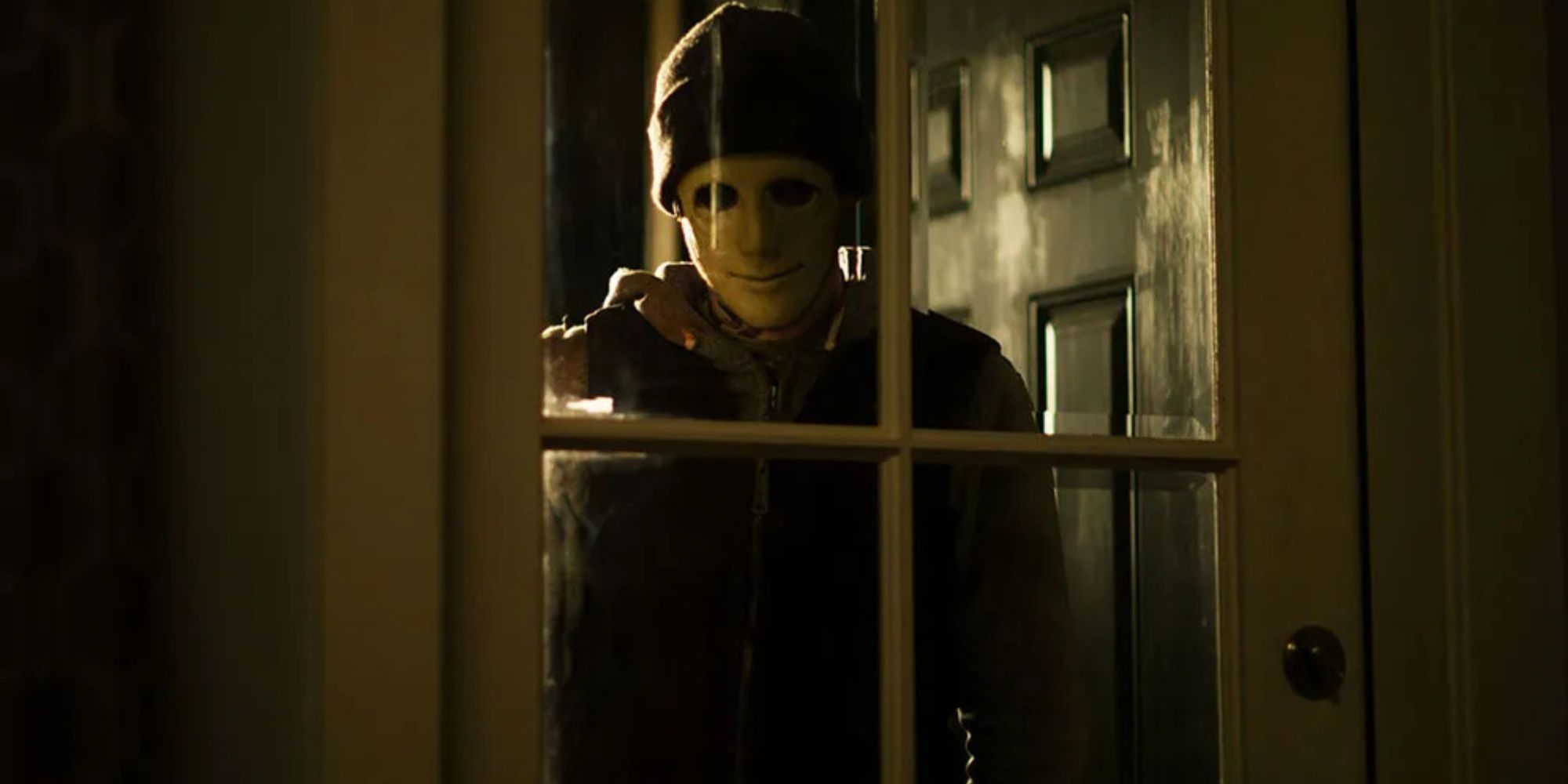
There have been countless home-invasion thrillers throughout horror history, but very few are as horrifying as Mike Flanagan’s Hush. Co-written and starring Flanagan’s frequent collaborator and real-life partner Kate Siegel, Hush tells the story of Maddie Young, a deaf and mute author living alone in a secluded cabin. A masked psychotic killer (John Gallagher Jr.) discovers her disability and terrorizes her, turning his pursuit into a sadistic game.
A modern take on Wait Until Dark, Hush is a tense, masterclass in minimalist suspense, featuring a remarkably innovative sound design that immerses audiences in Maddie’s world. It might be Flanagan’s greatest feature-length project in terms of sheer execution. Home-invasion stories are nothing new, but the way Flanagan explores the specifics of this thriller sets it apart. Further, he pushes beyond the weak-damsel trope. A wonderful subversion of horror themes, Hush benefits from Flanagan’s single-set-piece atmosphere and a terrifyingly realistic villain, making it anyone’s worst nightmare.
Audiences love twists that are warranted and earned; otherwise, they can bog down an entire story. Fortunately, in I See You, the twist-heavy psychological thriller does not disappoint. Directed by Adam Randall and written by** Devon Graye**, *I See You *tells the story of Greg Harper (Jon Tenney), a detective investigating a child’s disappearance while reeling from his wife Jackie’s (Helen Hunt) affair. Unbeknownst to the family, a sinister presence is terrorizing them in their home as items vanish, doors open, and televisions turn on.
With a tight, well-plotted script, I See You effortlessly blends genres, from supernatural horror to crime thriller. Twists are not easy, but the mid-film perspective shift is remarkable, making you question everything and everyone that came before. All of the pieces are interconnected, even though you likely didn’t realize it in real time. Randall masterfully directs the film, ensuring every camera movement has a purpose, hiding clues in plain sight. I See You is a terrifying premise because the threat of the unknown truth being closer to home is unsettling in its own right.
Essentially, every feature film prior to Doctor Sleep is a forgotten horror masterpiece by Mike Flanagan. Based on his short film, Oculus tells the story of siblings Kaylie and Tim (Karen Gillan and Brenton Thwaites), who attempt to destroy an antique mirror known as the Lasser Glass, which they believe caused their parents’ deaths 11 years earlier. As Kaylie gets closer to the truth, the mirror manipulates their perceptions, sanity, and reality, ultimately leading to a tragic, inescapable confrontation.
A mesmerizing psychological thriller, Oculus is a masterclass in storytelling that captures the struggles of overcoming trauma, with the monster being the inability to move on. It uses psychological breakdowns as a means to scare; while there are certainly some gory moments, they’re not overwhelmingly gratuitous. Co-written by Jeff Howard, Oculus is a wonderfully plotted, character-centric drama in which Gillan and Thwaites deliver phenomenal performances. The ending is nothing short of horrific, but Flanagan’s decision not to give anyone a happy ending proves his brilliance as a visionary.
When your film is released, and it’s deemed “filthy” and “sadistic,” chances are that outside of a cult following, longevity may not be in the cards. And yet, despite effectively killing Michael Powell’s career, Peeping Tom is a sensational project from a modern horror perspective. Perhaps a bit too dark and menacing for 1960, the British horror thriller tells the story of Mark Lewis (Carl Boehm), a disturbed, lonely focus puller who murders women while using a portable movie camera to film their dying expressions of terror. He uses the footage to create a documentary, driven by his traumatic childhood experiences.
An expert examination of voyeurism through filmmaking,* Peeping Tom* remarkably puts the audience behind the camera to see the world through the killer’s eyes. Its legacy is one of controversy: the disturbing subject matter pushed the bounds of psychological horror to places that perhaps audiences weren’t ready for. Yet, from a modern vantage, it’s a misunderstood film that was foundational to the slasher genre. Alas, when you come out during the same year as Psycho, it’s an uphill battle to be the predominant film. Nevertheless, Peeping Tom foreshadowed a modern society’s obsession with surveillance, media consumption, and instant media sharing.
Peter Medak’s 1980 film, The Changeling, follows John Russell (George C. Scott), a composer who moves into a secluded, haunted Victorian mansion near Seattle to grieve the tragic deaths of his wife and daughter. He soon discovers that a murdered child’s spirit is haunting the house. The child’s father murdered him and replaced him with an unrelated orphan to inherit a $70 million fortune.
Medak relies on a strong sense of atmosphere to keep the haunting alive. Further, John isn’t just a participant in the atmosphere; he is an active protagonist, using rationale through his investigation, rather than solely reacting to the action around him. The same year The Changeling was released, Friday the 13th came. With that film becoming an instant horror classic, it marked a shift in horror, signaling a turn away from slow-burning psychological thrillers toward slasher cinema. Further, as haunted-house movies have adapted to cinematic technology, The Changeling pales in comparison, appearing cheaper-looking.
Perhaps the main reason why The Devil’s Backbone falls on a list of forgotten films is that it’s been eclipsed by the director’s subsequent hits. Directed by Guillermo del Toro and written by del Toro, David Muñoz, and Antonio Trashorras, the Spanish-language film tells the story of Carlos (Fernando Tielve), a 12-year-old boy who, after losing his father, is sent to a remote orphanage, which also houses the Republican militia and politicians. There, he’s taken in by the steely headmistress Carmen (Marisa Paredes) and the kind professor Dr. Casares (Federico Luppi). After a violent altercation with violent caretaker Jacinto (Eduardo Noriega), Carlos encounters a young ghost and uncovers the school’s secrets involving war, greed, and murder.
Set in the final stage of the Spanish Civil War, The Devil’s Backbone blends historical allegory with a haunting ghost story, exploring trauma, lost innocence, and the idea that human beings can be more monstrous than the supernatural. The film depicts the horrors of humanity, with del Toro creating** a poignant, deeply emotional story that moves beyond pure horror**, thanks to the war elements that allow for thematic symbolism. The Devil’s Backbone is an emotional thriller that, compared to the rest of del Toro’s body of work, is more low-key and was overshadowed by the masterpiece known as Pan’s Labyrinth.
Based on the graphic novel by Cullen Bunn and Vanesa R. Del Rey, The Empty Man follows James Lasombra (James Badge Dale), a troubled ex-cop investigating local teenagers’ disappearances linked to a sinister urban legend, uncovering a nihilistic cult known as the Pontifex Institute that is trying to summon an entity. A philosophical supernatural horror thriller, The Empty Man** **tackles themes of grief, belief, and a descent into madness through the lore of an urban legend.
Building upon the inherent intellectual depth of the script, The Empty Man defies many classic horror tropes to lean into a deeply unsettling, philosophical, and atmospheric cosmic horror experience. A masterfully tense atmosphere-building pushes the paranoia-inducing scenes to the max, especially those on the bridge and in the forest, all thanks to the strong technical craft. Despite its quiet release in the age of COVID-19, The Empty Man is one of the best horror films you likely never knew about.
](/tag/horror/)