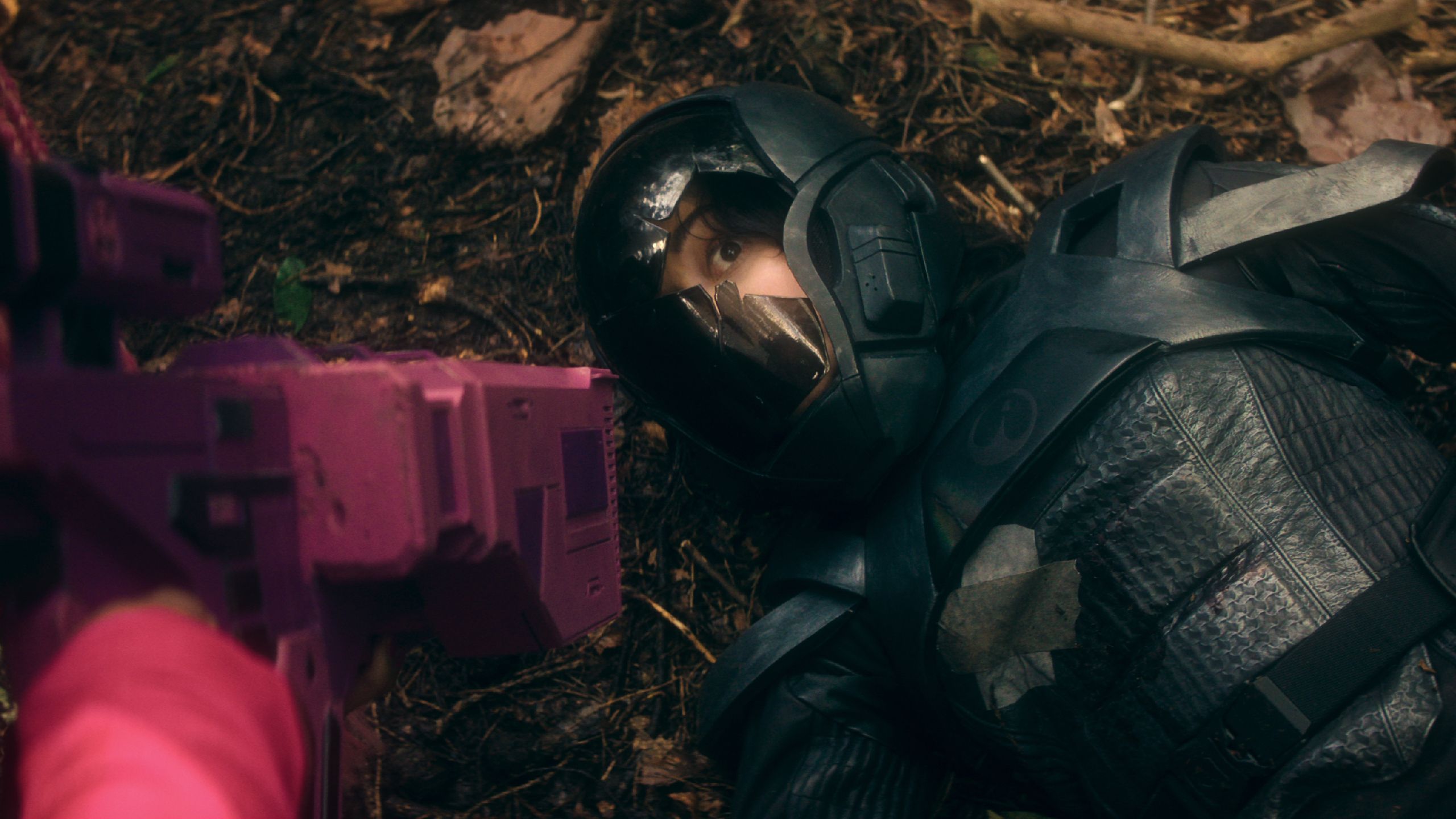
Netflix’s Black Mirror has built a formidable reputation for bold, unsettling storytelling that regularly defies expectations. However, as inventive as Black Mirror can be, there’s another Netflix anthology that not only matches it when it comes to delivering ambitious and weird sci-fi, but surpasses it entirely.
That show is Love, Death & Robots, which first arrived on Netflix in 2019 and has since expanded to four seasons. Created by Tim Miller, LD+R is a dizzying animated anthology that takes a similar formula to Black Mirror but pushes it in a far wilder direction. While Black Mirror is often celebrated as Netflix’s go-to for strange, thought-provoking sci-fi, it doesn’t come close to matching Love, Death & Robots when it comes to sheer unpredictability.
Where Black Mirror experiments within certain boundaries, LD+R gleefully ignores them. For anyone whose appetite for unconventional sci-fi has been sparked by Black Mirror, Love, Death & Robots feels like the natural next step, and a far more daring one at that.
Black Mirror has long been praised for pushing sci-fi boundaries, but Love, Death & Robots operates on an entirely different level of creative freedom. The live-action format of Black Mirror inherently grounds it, even when its ideas are outlandish. By contrast, the animation of Love, Death & Robots keeps it unrestricted and capable of delivering stories that would be impossible to produce in live action.
Take “Zima Blue,” for example. This season 1 Love, Death + Robots episode tells the story of an artist whose obsession with a single color leads to a profound existential revelation about personhood and AI. Its minimalist, almost hypnotic animation style perfectly complements its philosophical narrative. On the opposite end of the spectrum is “Night of the Mini Dead,” which presents a zombie apocalypse through a time-lapse, miniature-style lens. There’s also the semi-live-action “Ice Age”, which sees a couple played by Topher Grace and Mary Elizabeth Winstead discover an entire civilization in their freezer.
Episodes like these are where Love, Death & Robots truly outshines Black Mirror when it comes to innovation, and this is only possible due to the inherent freedom of animation. Black Mirror may flirt with the bizarre, but it often pulls back to maintain its commitment to themes of technoparanoia and speculative futurism. Love, Death & Robots has no such hesitation. It embraces the strange, the surreal, and the outright incomprehensible. In doing so, it pushes anthology sci-fi further than Black Mirror has ever dared.
The same creative freedom that allows Love, Death & Robots to outdo Black Mirror in terms of experimentation also gives it a significant edge in longevity. While Black Mirror often bases its stories on plausible technological advancements, that grounded realism can quickly become a limitation. As real-world technology evolves, many of its once-speculative ideas begin to feel less like science fiction and more like present-day reality.
A clear example is Black Mirror’s “The Entire History Of You.” When it first aired in 2011, the concept of recording and replaying memories through a contact lens paired with a brain chip felt futuristic and unsettling. Today, however, with the rise of smart glasses and constant digital documentation, the season 1 episode feels far less speculative. Its emotional core of technology fueling possessive toxicity in a relationship remains strong, but its sci-fi edge has undeniably dulled.
This is a problem Black Mirror will continue to face. By anchoring its stories in near-future realism, it risks becoming outdated as that future catches up. Love, Death & Robots, on the other hand, avoids this issue entirely. Its stories are often so detached from reality that they aren’t tied to any specific moment in time. This makes them far more resilient.
Because it doesn’t aim to predict the future, Love, Death & Robots isn’t starting to show its age in the same way as Black Mirror. The series isn’t concerned with being plausible, it’s concerned with being memorable. That difference is crucial. While Black Mirror continues to deliver compelling stories, its reliance on realism may ultimately limit its longevity. Love, Death & Robots, by fully embracing the weird and the unexpected, ensures that its episodes will remain just as captivating years down the line.
Love, Death & Robots ](/db/tv-show/love-death-robots/)
](/tag/animation/)
](/tag/horror/)
Science Fiction
](/tag/sci-fi/)
](/tag/thriller/)
Víctor Maldonado, Patrick Osborne, Robert Valley, Alfredo Torres Martínez, Jerome Chen, Emily Dean, Rémi Kozyra, Léon Bérelle, Dominique Boidin, Alberto Mielgo, Maxime Luère, Andy Lyon, Robert Bisi, Dave Wilson, David Nicolas, Simon Otto, Damian Nenow, Laurent Nicolas, Kevin Van Der Meiren, Vitaliy Shushko, Owen Sullivan, István Zorkóczy, Javier Recio Gracia, Oliver Thomas
Tim Miller, Philip Gelatt