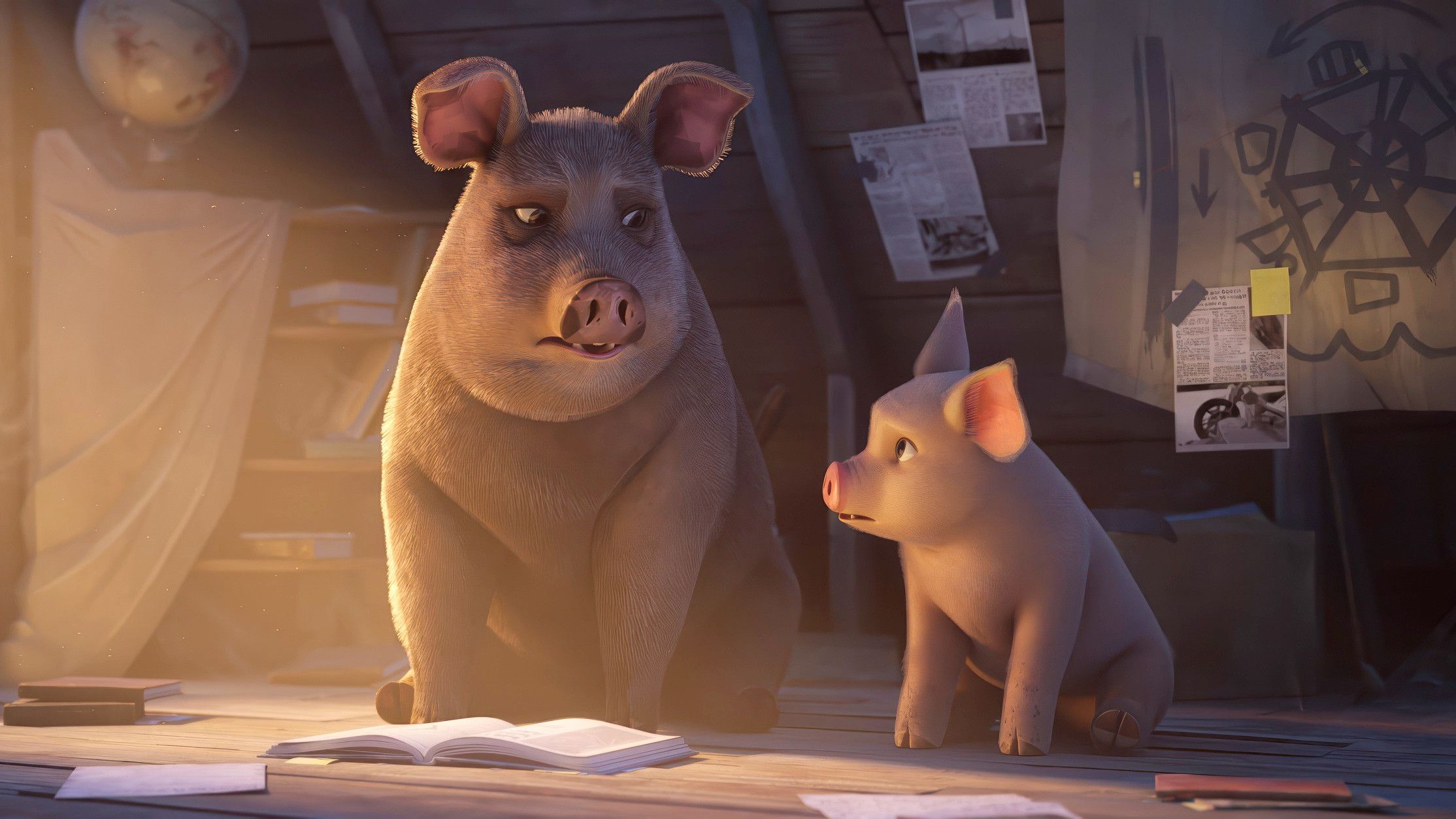
With a voice cast this star-studded put toward source material with decades of success behind it, Animal Farm should have been a slam dunk. That only makes it all the more bewildering that this film misses the mark at every turn, betraying the very message that George Orwell set out to convey in 1945. Andy Serkis’ animated Animal Farm* *has been raising red flags since its first trailer was released last December. Among the concerns was that its animation looked AI generated, even if it wasn’t, but a much more prominent complaint had to do with the story itself.
When paired with the animation style, the tone that was evident in the trailer alone felt geared toward a much younger audience than one would anticipate for this story. Yes, *Animal Farm *has been taught in middle schools for decades (although it has also found itself banned on more than one occasion). But what with its fart jokes and silly, over-the-top scenes, the target demographic of this new adaptation seemed to skew even younger.
Out of the gate, that’s a problem. Orwell’s Animal Farm, despite telling its story through animals, is a poignant, nuanced allegory depicting how revolution and rebellion can lead to authoritarianism – even when the ideologies start out in the right place. Hardly fodder for the latest mindless kiddie flick. Any film version should be an exploration of the way a seemingly free government can incrementally gain total control and manipulate its constituents into handing over their power. Instead, audiences of this woefully misguided *Animal Farm *are treated to a celebrity pig named NaPoPo wearing bling and becoming a de-fanged caricature.
Orwell’s *Animal Farm *drew directly from the real-life story of the Russian Revolution, which saw the Czar overthrown in 1917 (and brutally killed alongside his wife, son, and three daughters in 1918), only for this rebellion against the Russian Empire to ultimately develop into Vladimir Lenin’s, and then Joseph Stalin’s, Soviet Union. The pigs, as stand-ins for the Soviet political leaders of the time, establish the titular “Animal Farm” and refuse to live under the thumb of farmers who exploit and mistreat them.
In place of that system of power, wherein farm animals are subservient to farmers, the animals establish a seemingly free government and agree on seven commandments, which include rules like *“All animals are equal” *and *“No animal shall kill any other animal,” *although there are also commandments against things like animals wearing clothes or drinking alcohol. Over the course of the story, however, the leader, Napoleon, manipulates these rules for his own gain, eventually donning clothes and walking on two legs. He also carries out a host of horrors, including executing dissenters. Not even piglets are exempt.
Chillingly, the book ends with the pigs in power sharing a meal with humans, the two species now being entirely indistinguishable from one another. Audiences were right to be dubious that an animated kids movie could hit these same points. But this film’s sins go beyond shying away from the executions of young pigs or the book’s haunting, unhappy ending. The filmmakers’ changes have resulted in the complete bastardization of the original story and its meaning.
In place of a critique of authoritarianism and an exploration of how dictators rise to power, *Animal Farm takes the laziest road possible to arrive at the declaration that absolute power corrupts absolutely. In fact, as if it *hadn’t already done enough hand holding by that point, the movie force-feeds this message to audiences by having Napoleon (Seth Rogen) say those words. Painfully on the nose, and, even more problematically, completely unearned. The movie hasn’t actually demonstrated that point at all.
Rather than an insidious dictator who weaponizes an ideology of freedom and equality to gain power, Napoleon is corrupted by the real ‘bad guys’ in this version of the story: humans. Freida Pilkington (Glenn Close), based on the farmer Mr. Pilkington in the book (who is notably described as “easy-going”), is the primary villain, and she brings things like sports cars and facelifts to Animal Farm. There’s a message to be found in that swap, although it’s the very crux of the issue with this movie. *Animal Farm *abandons profundity for a boring, puritan criticism of modern-day culture.
That puritanism permeates the entire narrative, down to the use of the term *“naughty juice” *in place of alcohol, which is enough to give any adult viewer secondhand embarrassment. At the same time as it inexplicably sanitizes, the movie also adds unnecessary plot, such as a budding romance between Lucky (Gaten Matarazzo) and Puff (Iman Vellani), neither of whom are in the book. Lucky is an obvious insert character for young viewers, though that only makes it all the stranger that the movie needed these piglets to pine for one another.
It’s worth mentioning that the book characters Puff and Lucky most closely resemble are the four young pigs who speak out against Napoleon’s rule and are ultimately the first to be executed. That fate is far from the banal happily-ever-after these piglets get, complete with a heavy-handed message about how helping one another is true freedom. In fact, there’s no battle in the movie, nor is there any direct execution. The closest the movie gets is Boxer being taken away by a helicopter clearly labeled “fine glue” (because why trust the audience to figure anything out for themselves?).
Most egregious of all, however, is the image in the credits that depicts protesters as pigs, implying that protesters are part of the problem. Ultimately, Serkis’ *Animal Farm *swaps out Orwell’s brave questions for a different one: What if an animated movie spent millions of dollars bringing to life a classic work of literature with a legendary cast, only to target entirely the wrong demographic, completely abandon the message that’s endured for 80 years, and tell a story that has nothing instructive or valuable to offer its audience? Some adaptations, it seems, are far less equal than others.
](/db/movie/animal-farm-3440807/)
](/tag/animation/)
](/tag/comedy/)
Nicholas Stoller
Dave Rosenbaum, Jonathan Cavendish, Nicholas Stoller, Connie Nartonis Thompson, David Rosenbaum, Adam Nagle