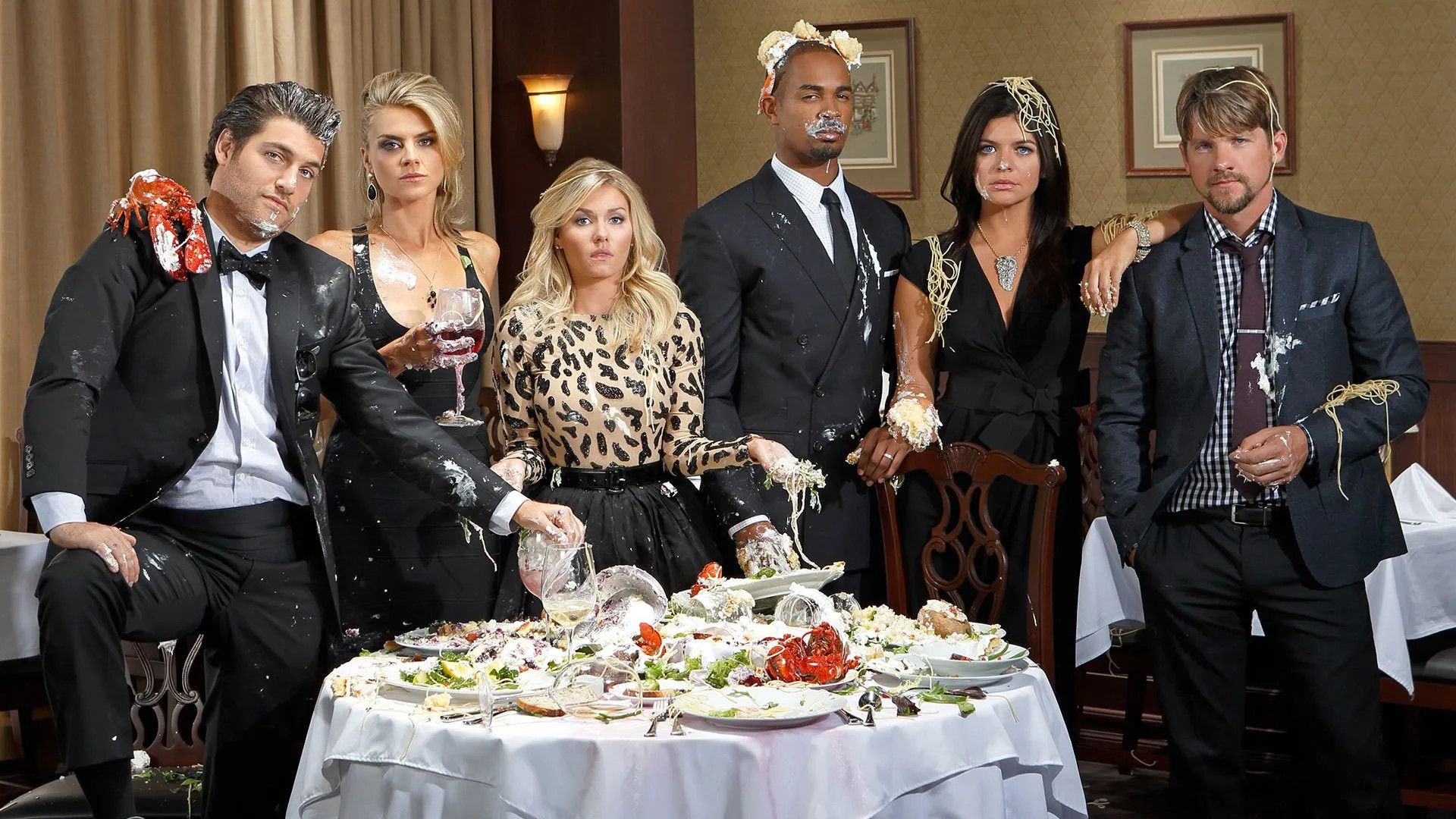
Hangout sitcoms thrive because they feel like spending time with old friends. The best hangout sitcoms are ensemble comedies centered on friends simply spending time together with minimal stakes. The earliest versions go back decades, from bar-centered ensembles to roommate comedies and friend-group dynamics in shows like Cheers and Three’s Company.
Sitcoms in the 1990s really crystallized the hangout format into cultural giants. Friends turned everyday friendship into a global blueprint for ensemble comedy, while Seinfeld refined the idea into something more observational and ironic, built around friends simply existing and talking.
Together, they established the modern language of the hangout sitcom, where plot often takes a backseat to character chemistry, and recurring spaces like apartments and coffee shops become iconic. The appeal of these types of comedies comes from watching a friend group feel like a permanent, familiar orbit.
Modern-era staples carried the hangout sitcom into a new television era by refining the familiar formula for a more serialized, character-driven audience. How I Met Your Mother is a masterpiece that layered its friend-group hangouts with long-running storytelling and emotional callbacks.
The best Big Bang Theory episodes anchored the ensemble cast around shared apartments, recurring routines, and social dynamics that played out in familiar spaces. New Girl leaned more directly into pure hangout energy, using a shared loft as the center of a constantly shifting friendship group.
These 2010s sitcom giants have become perennial fan favorites. However, with so much attention concentrated on a few iconic titles, a number of smaller but equally sharp hangout sitcoms get pushed to the margins. These lesser-known series may not have achieved the same mainstream longevity, but they are just as rewarding for viewers willing to look beyond the obvious classics.
Friends from College feels like Netflix’s attempt to create a messier, more adult evolution of the classic friend-group hangout sitcom. Instead of twenty-somethings navigating early adulthood, the show follows a tight-knit group in their forties dealing with marriages, careers, jealousy, and lingering romantic baggage.
The premise allows for the same overlapping relationships and group dynamics that power traditional hangout comedies, but with sharper edges and more uncomfortable honesty. The ensemble cast of Friends from College is stacked with strong comedic talent, led by Keegan-Michael Key and Cobie Smulders, and the cast’s chemistry sells both the humor and the dysfunction.
Despite that, the series never quite broke through, perhaps because its cringe-heavy tone made it less cozy than its predecessors. Still, Friends from College’s commitment to flawed friendships and chaotic group energy makes it an underrated entry in the hangout sitcom tradition.
Don’t Trust the B---- in Apartment 23 arrived as a midseason replacement on ABC, but its quirky, offbeat voice quickly helped it stand out enough to earn a second season. The sitcom thrives on the odd-couple dynamic between naive Midwestern newcomer June (Dreama Walker) and her chaotic, unapologetically selfish roommate Chloe (Krysten Ritter).
The series also leans into absurdity with the late James Van Der Beek playing a heightened, self-aware version of himself, adding to its unpredictable tone. Anchored by Kristen Ritter’s fearless performance as the B**** in Apartment 23, the comedy embraces its weirdest instincts.
Despite strong comedic talent and a distinct personality, the show never found a large audience. It’s one of the strangest, funniest hangout sitcoms that viewers barely remember today.
The Last Man on Earth turns a high-concept apocalypse into an impressively intimate character study. Rather than focusing on survival mechanics, the series becomes a charming hangout sitcom about a mismatched group forming an unlikely found family after the end of the world.
Created by and starring Will Forte, the show leans into awkward dynamics, shifting romances, and small interpersonal conflicts that feel surprisingly grounded. It also had strong creative backing, with executive producers Phil Lord and Christopher Miller, the directing duo behind Project Hail Mary.
Like many underrated comedies, it debuted as a midseason replacement for Fox and gradually built momentum. Unfortunately, despite its growing ensemble and evolving dynamics, The Last Man on Earth ends on a frustrating season 4 cliffhanger.
Workaholics might sound like a workplace comedy, but the title is misleading. The series is really about three college friends who refuse to grow up, even if they now share both an office and a house. Their telemarketing job is mostly background noise, with episodes focusing on half-baked schemes, partying, and the trio’s shameless commitment to avoiding responsibility.
The show ran for an impressive seven seasons on Comedy Central, powered almost entirely by the chaotic chemistry of creators and stars Blake Anderson, Adam DeVine, and Anders Holm. Their willingness to push jokes into absurd, cringe-heavy territory gives Workhaolics its identity. Fans of Broad City in particular should seek out this unapologetic, stoner-leaning hangout comedy.
Grand Crew feels like a blend of Friends and Insecure, centering on a tight-knit group of Los Angeles friends who regularly gather at their favorite wine bar to unwind, debate relationships, and navigate adulthood. The hangout structure gives the sitcom a relaxed, conversational rhythm, with episodes driven more by group dynamics than plot.
It was a charming NBC comedy that never quite found its audience. Grand Crew got just two short 10-episode seasons when most ensemble sitcoms need time to refine their voice.
The pilot also featured Garrett Morris as a narrator, a device that was quickly dropped. That added flavor could have given the show a distinctive, How I Met Your Mother-style framing hook, helping the series stand out in a crowded comedy landscape and potentially build stronger momentum.
Single Parents is an underrated gem about a group of single parents at the same elementary school who become unlikely friends while navigating dating, work, and the chaos of raising kids. The adult ensemble is unsurprisingly strong, with Taran Killam, Leighton Meester in a rare comedic role, and Brad Garrett all bringing warmth and sharp timing.
What’s more surprising is how well the child actors hold their own, especially the twins playing Garrett’s daughters, who consistently land some of the show’s funniest moments. The title may have limited its audience, but the series is really about friendship and keeping your spark alive when adulthood feels overwhelming. Sweet, funny, and character-driven, Single Parents remains criminally underseen.
Coupling was created by Steven Moffat before he went on to run Doctor Who and co-create Sherlock. Loosely inspired by his own relationships, it was his attempt at a Friends-like sitcom for the BBC, built around six friends whose dating lives constantly overlap and collide.
The series was popular in the UK, but never a dominant hit, and it failed to make a meaningful impact in the U.S. market. Heavily dialogue-driven, it turned dating anxiety, romantic misfires, and social embarrassment into rapid-fire, intricately written comedy that feels bold, chaotic, and sharply observant in a way few sitcoms of its era attempted.
Moffat’s writing is fast, structured, and highly “engineered,” with overlapping timelines and repeated scenes from different perspectives. That approach makes Coupling feel less like a traditional sitcom and more like a tightly constructed comedy puzzle box.
Workin’ Moms chronicles the lives of five mothers who form unlikely friendships through a provocative “Mommy and Me” class, bonding over the chaos, humor, and exhaustion of modern urban motherhood. Though centered on motherhood and womanhood, the writing is sharply funny, emotionally honest, and observational in a way that makes it broadly relatable to any viewer.
Workin’ Moms was a moderate hit in Canada, where it ran for seven seasons on CBC, and later developed a cult audience in the U.S. via streaming. However, it still never quite received the wider recognition its writing and performances arguably deserved as a female-centric hangout sitcom.
Crashing was an early series created by and starring Phoebe Waller-Bridge, following six twenty-somethings living together as property guardians in a disused hospital, keeping the building safe in exchange for cheaper rent and a strict set of rules. As the group’s close living situation intensifies, relationships begin to overlap, blurring boundaries between friendship and romance.
Not to be confused with HBO’s semi-autobiographical Pete Holmes series, this version plays like a warped, off-kilter take on Friends, twisting familiar sitcom tropes into something more uncomfortable and emotionally raw. It remained more of a cult, critically noted debut than a breakout hit. The series also features a young Jonathan Bailey, before his rise in Bridgerton and Wicked.
Living Single was a contemporary of Friends, but with a sharper, more grounded energy and a distinctly Black cultural perspective that set it apart. Set in Brooklyn rather than Manhattan, the series followed a tight-knit group of friends navigating careers, dating, and independence with humor and confidence.
The cast of Living Single, including Queen Latifah and Erika Alexander, brought charisma and authenticity that made the ensemble feel lived-in and dynamic. Its focus on friendship as a genuine support system rather than romantic entanglement gave the sitcom a warmth and rhythm that felt ahead of its time.
It didn’t reach the same mainstream global dominance as Friends in part due to network positioning on Fox and timing. Nevertheless, Living Single remains one of the strongest pure hangout sitcoms.