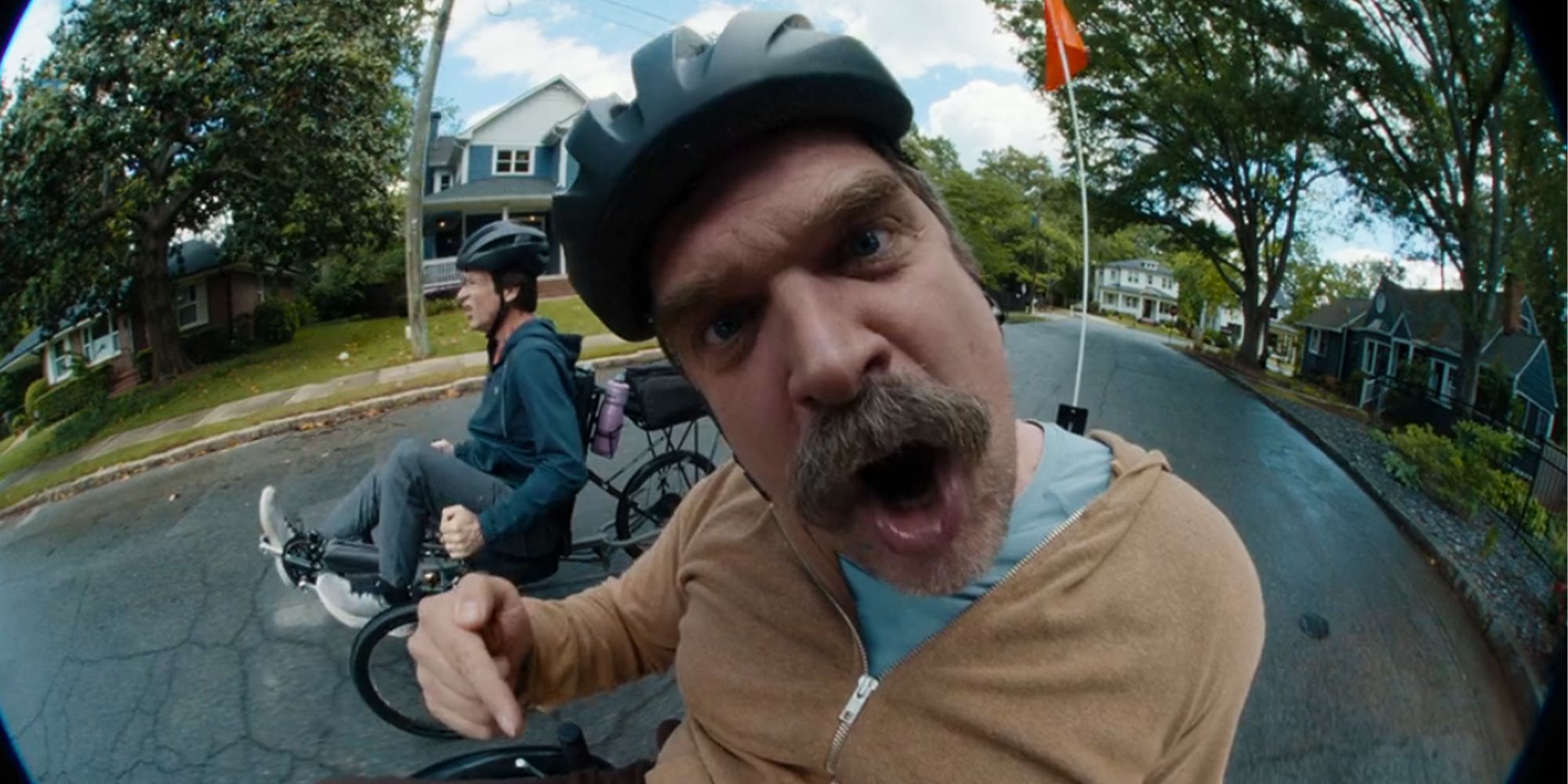
Floyd Smernitch is dead. That’s not a spoiler. By the time Episode 1 of ***DTF St. Louis ***is complete, the wholesome, lovable, out-of-shape character played by David Harbour has already passed away. The latest HBO miniseries follows the unusual circumstances surrounding the suburban stepdad’s untimely death. However, the story isn’t told in a linear fashion. With four episodes having aired, the series is revealing more and more about each character in the months, weeks, and days leading up to the moment police find the body. In Floyd’s case, each episode continues to highlight just how good of a friend, husband, and father figure he truly was.
The inevitability of Floyd’s death makes audiences feel even more empathy towards this character. And why not? He’s the perfectly written protagonist. Both Floyd’s loyalty and acts of kindness are the proof in the pudding that he’s a good guy. Whether it’s something low-key like bringing cornhole boards over to Clark’s house for a party, or more important acts such as teaching Clark ASL in his free time. It’s easy to see why Floyd is such a likable human. Not to mention the way he cares for his family. He’s not just the stepdad, Floyd truly is the dad who stepped up. He’s seemingly the only person who can reach his wife’s son Richard on an emotional level. With that much depth, it’s time we said goodbye to the David Harbour characters of old.** **Violent Night, Stranger Things, Black Widow, say hello to Floyd Smernitch.
Kudos to creator **Steven Conrad **for developing this character in a way that’s reassuring to audiences. In all likelihood, Floyd Smernitch did not take his own life. There is comfort in that assumption. Floyd loves his job as an ASL interpreter. He loves his wife even when she treats him poorly and wears her umpire gear around the house. He loves his stepson, and is willing to go to therapy in order to work on their strained relationship. He loves Clark like a brother. The big takeaway is that Floyd’s capacity to love is greater than any other character in this series. That’s not the kind of person who typically chooses to take their own life.
Even when life is difficult, Floyd** never stops searching for the joy in the world**. He buys Carol earrings even though they are struggling with money. He calls her Carol Love, which is not only her maiden name, but he’s turned it into a term of endearment. He spends time supporting and getting to know Richard on a personal level. His mantra during gym sessions with Clark is “B out the B,” which stands for “Bring out the best.” There’s no other character as genuinely kind-hearted in this twisted suburban setting that HBO has created.
Your answers point to the world your instincts were built for.
You took the red pill a long time ago — probably before anyone offered it to you. You’re a systems thinker who can’t help but notice the seams in things, the places where the official version doesn’t quite line up. In the Matrix, that instinct is the difference between life and permanent digital sedation. You’d find the Resistance, or it would find you. The machines built an airtight prison. You’d be the one probing the walls for the door.
The wasteland doesn’t reward the clever or the well-connected — it rewards those who are hard to kill and harder to break. That’s you. You don’t need comfort, community, or a cause larger than the next horizon. You need a vehicle, a clear threat, and enough fuel to outrun it. You are unsentimental enough to survive that world, and decent enough — just barely — to be something more than another raider.
You’d survive here because you know how to exist in moral grey areas without losing yourself completely. You read people accurately, keep your circle small, and ask the questions others prefer not to answer. In a city where humanity is a legal designation rather than a feeling, you hold onto something that keeps you functional. You’re not a hero. But you’re not lost, either. In Blade Runner’s world, that distinction is everything.
Arrakis is the most hostile environment in the known universe — and you are precisely the kind of person it rewards. Patience, discipline, pattern recognition, political awareness, and an understanding that the long game matters more than any single victory. Others come to Dune and are consumed by it. You’d learn its logic, earn its respect, and perhaps, in time, reshape it entirely.
The galaxy far, far away is vast, loud, and in a constant state of violent political upheaval — and you wouldn’t have it any other way. You’re someone who finds meaning in being part of something larger than yourself. You’d gravitate toward the Rebellion, or the fringes, or whatever pocket of the galaxy still believes the Empire’s grip can be broken. Whatever you are, you fight. And in Star Wars, that willingness is what makes the difference.
After four episodes, *DTF St. Louis *has revealed very little information about Carol’s former marriage and Richard’s biological father. None of that matters to Floyd. In fact, he jumps right into the father figure role as early as Episode 1 of the series. Floyd goes as far as to emphasize to Richard, “I want to be around for a long time because of you.” The sentiment is incredibly thoughtful and kind, even more so given that their relationship is still awkward and a bit uncomfortable.
Floyd’s care could be mistaken as fake or phony, but it is genuine. When their therapy sessions start to get stale, the father/son duo begin spending time with one another at a local park. Floyd also takes Richard to visit a potential new private school. One of Floyd’s biggest financial concerns was how to afford tuition so that Richard might be able to thrive. Not to mention, Floyd insists on letting Richard continue to wear his bizarre fishing vest to school, even against Carol’s wishes. These aren’t the actions of someone feigning love or pretending to care about a kid just to impress the mother.
In 49 Minutes, HBO’s 7-Part Dark Comedy Miniseries Revealed Its Most Unexpected Villain ](/dtf-st-louis-episode-1-villain-explained/)
Jason Bateman makes for the perfect red herring.
David Harbour is known for portraying the rugged, strong, masculine characters who usually have a chip on their shoulder. His resume is chock-full of these roles. Look at Jim Hopper in Stranger Things, Alexei in Thunderbolts*, even Santa Claus in *Violent Night. *These are all very sharp characters, and that’s been Harbour’s bread and butter. The role of Floyd Smernitch is completely refreshing. Although he may look like the burly David Harbour that audiences have come to expect, Floyd is a big, cuddly teddy bear with an even bigger heart.
Credit where credit is due, Harbour does a wonderful job of toning down the aggressive nature that he carries in most of his roles. The softening of those edges makes Floyd incredibly relatable. He also brings a much-needed comedic relief to a dark murder mystery. Unfortunately, those characteristics make his death even more tragic. The contrast of Harbour’s brilliant performance against the likes of his costars **Linda Cardellini **and **Jason Bateman **only amplifies the goodness in Floyd. David Harbour continues to dig deeper, and he’s only going to get better as the series moves along.
As a miniseries, it’s very likely that *DTF St. Louis *will close up shop after one season. There’s no doubt, however, that Floyd Smernitch has etched his name as one of the most interesting, wholesome, and genuine characters on television. David Harbour deserves recognition for his work on this project, as he brings out the best in his castmates. “B out the B,” as they say.
](/tag/tv-show/dtf-st-louis/)
2026 - 2026-00-00